

Can Diagnostic Scans Pinpoint the Real Cause of Poor Fuel Economy
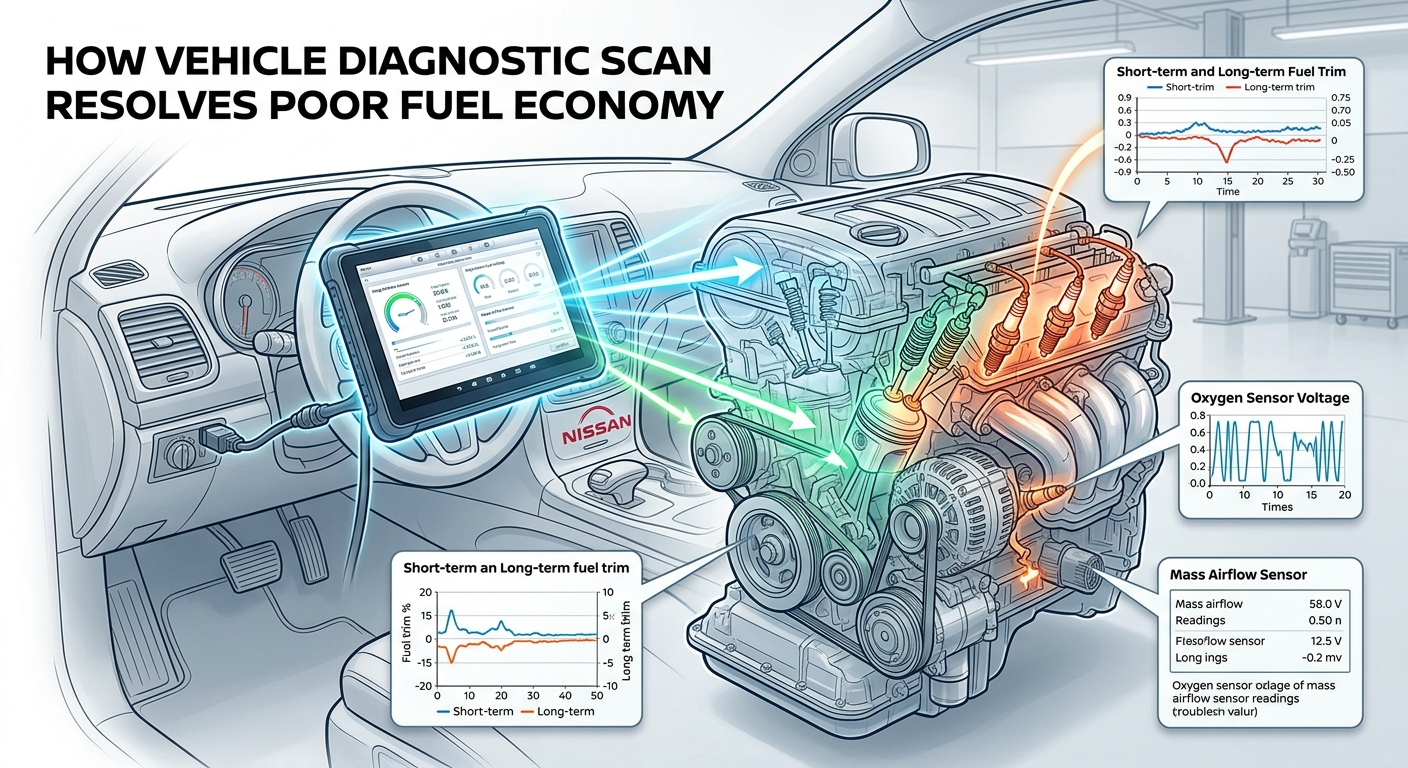
A sudden drop in fuel economy can be incredibly frustrating, especially when there are no obvious puddles under your car or smoke coming from the tailpipe. Drivers often wonder if a professional diagnostic scan can actually pinpoint the root cause of poor gas mileage. The short answer is yes. Modern vehicles are equipped with highly sophisticated On-Board Diagnostics (OBD-II) systems that constantly monitor engine performance, emissions, and fuel delivery. When something disrupts the delicate balance of air and fuel in the combustion chamber, the vehicle’s computer logs a specific fault code.
When you bring your vehicle in for a diagnostic service, our technicians connect a specialized scanning tool to your car’s OBD-II port. This tool does far more than just read basic trouble codes. It pulls real-time operational data, allowing us to analyze fuel trim values, sensor voltages, and engine temperatures as they occur. For example, if your engine is running “rich”—meaning it is injecting too much fuel and not enough air—the diagnostics will show elevated fuel trim percentages. This precise data directs our service team straight to the malfunctioning component, saving you from the expensive guesswork of throwing random parts at the problem.
Identifying these issues early prevents minor inefficiencies from turning into catastrophic engine damage. If your vehicle is burning more fuel than it should, you can (615) 442-3090 to speak directly with our service advisors. We can help you schedule an appointment to run a complete system scan and restore your vehicle to its peak operating efficiency. If you are already out running errands, you can easily find directions to our service department to get your vehicle evaluated by factory-trained professionals.
Table of Contents
- Mechanical Engine Culprits That Silently Drain Your Gas Tank
- How Restrictive Air Filters and Worn Spark Plugs Sabotage Engine Efficiency
- Recognizing the Warning Signs of a Failing Oxygen Sensor or Bad Thermostat
- The Direct Impact of Tire Pressure and Wheel Alignment on Fuel Consumption
- Selecting High-Efficiency Vehicles for Commutes
- Quick Answers to Common Questions About Vehicle Diagnostics and Fuel Mileage
- Keep Your Vehicle Running Efficiently
Mechanical Engine Culprits That Silently Drain Your Gas Tank
While some fuel economy issues present themselves with a flashing warning light on your dashboard, several mechanical culprits can silently drain your tank without triggering an immediate alert. A primary example is a failing fuel injector. Over time, carbon deposits can build up on the injector tips, causing them to spray fuel in a weak stream rather than a fine, atomized mist. This poor atomization leads to incomplete combustion, meaning your engine must burn more fuel to generate the same amount of power.
Another common mechanical issue is a sticking brake caliper or a failing wheel bearing. While these are not internal engine parts, they create mechanical drag that forces your engine to work significantly harder to maintain highway speeds. It is similar to driving up a perpetual hill. If you are driving an older vehicle that is starting to experience these compounding mechanical wear issues, it might make financial sense to explore upgrading to a newer, more efficient model rather than investing in continuous repairs.
For drivers looking to transition into a highly efficient vehicle, we offer a wide variety of reliable pre-owned options. You can browse affordable cars on our lot to find a vehicle that fits your daily driving needs perfectly. If you want to establish a specific budget, you can easily shop used vehicles under $20K or explore slightly newer models when you shop used vehicles under $30K.
To put modern mechanical efficiency into perspective, look at the engineering of a modern sedan like the Nissan Altima. The vehicle utilizes an advanced 2.5L four-cylinder engine paired with an Xtronic CVT to optimize every drop of fuel. In its front-wheel-drive configurations, this powertrain delivers 188 hp and 180 lb-ft of torque. By matching precise electronic fuel injection with a continuously variable transmission, the vehicle eliminates the mechanical inefficiencies and gear-hunting common in older drivetrains.
Engine & Performance
Powertrain specs by trim
| Feature | SR | SR AWD | SV | SV AWD |
|---|---|---|---|---|
| Engine | 2.5L | 2.5L | 2.5L | 2.5L |
| Horsepower | 188 hp | 182 hp | 188 hp | 182 hp |
| Torque | 180 lb-ft | 178 lb-ft | 180 lb-ft | 178 lb-ft |
| Transmission | Xtronic CVT | Xtronic CVT | Xtronic CVT | Xtronic CVT |
| Drivetrain | Front-wheel drive | All-wheel drive | Front-wheel drive | All-wheel drive |
Fuel Economy
Fuel economy and range by trim
| Feature | SR | SR AWD | SV | SV AWD |
|---|---|---|---|---|
| MPG | 26 city / 36 hwy / 30 combined | 25 city / 33 hwy / 28 combined | 26 city / 36 hwy / 30 combined | 25 city / 33 hwy / 28 combined |
How Restrictive Air Filters and Worn Spark Plugs Sabotage Engine Efficiency
Your engine requires a precise mixture of air and fuel to run efficiently. When key maintenance items like air filters and spark plugs are neglected, this balance is thrown entirely out of order. An engine air filter acts as the lungs of your vehicle, trapping dust, pollen, and road debris before they can enter the combustion chamber. When the filter becomes heavily restricted by dirt, the engine must work harder to draw in air, which can hurt throttle response and acceleration, forcing you to press deeper on the gas pedal to keep up with traffic.
Spark plugs are equally vital to your fuel economy. A spark plug must deliver a strong, consistent electrical spark at an exact microsecond to ignite the air-fuel mixture. As spark plugs age, the gap between the electrodes widens due to metal erosion. This wider gap requires more voltage to jump, leading to weak sparks or intermittent misfires. When a cylinder misfires, the unburned fuel is simply pumped out through the exhaust system, completely wasted.
Keeping up with these simple maintenance items is the easiest way to protect your wallet at the pump. If you are looking to trade in a vehicle that has fallen behind on maintenance, you can browse used cars in our inventory to find a well-maintained alternative. Commuters looking for a reliable, fuel-sipping daily driver can browse used Nissan Altima inventory for a comfortable cabin, while those who need a versatile crossover can browse used Nissan Kicks inventory to find an efficient and nimble ride for navigating local traffic.
Recognizing the Warning Signs of a Failing Oxygen Sensor or Bad Thermostat
Two of the most common electronic and thermal components that directly impact your fuel mileage are the oxygen sensor and the engine thermostat. The oxygen sensor measures the amount of unburned oxygen in the exhaust gases and sends this data to the engine control unit. The computer uses this information to constantly adjust the fuel delivery. If the oxygen sensor degrades or fails, it typically defaults to a “rich” fuel mixture as a safety precaution to prevent engine overheating. This failure can quietly decrease your overall fuel economy by up to 40 percent.
Similarly, a bad engine thermostat can severely hurt your fuel efficiency. If a thermostat becomes stuck in the open position, coolant will constantly flow through the engine, preventing it from reaching its optimal operating temperature. Because engines are designed to run most efficiently when warm, the vehicle’s computer will continue to inject extra fuel to try and heat the engine up, essentially keeping the vehicle in a cold-start “warm-up” mode indefinitely.
If you notice your temperature gauge staying unusually low or your gas gauge dropping faster than normal, it is time to have your vehicle inspected. For drivers who are considering trading in their current vehicle for something more dependable, we provide a variety of budget-friendly choices. You can shop used vehicles under $10K to find highly affordable transportation, or browse used Nissan inventory to view our full selection of pre-owned cars, trucks, and SUVs. If you need assistance with financing options for your next purchase, our team is here to help you secure competitive rates through our bad credit financing programs.
The Direct Impact of Tire Pressure and Wheel Alignment on Fuel Consumption
Fuel efficiency is not solely determined by what happens under the hood; your connection to the road plays a massive role. Under-inflated tires are one of the most common causes of poor gas mileage. When a tire lacks proper air pressure, it sags, which increases the contact patch between the rubber and the pavement. This extra surface area creates rolling resistance, forcing your engine to burn more fuel just to keep the vehicle moving. For every 1 psi drop in all four tires, your fuel economy drops consistently.
Improper wheel alignment acts as another silent drag on your fuel tank. When your wheels are out of alignment, they do not point in the exact same direction. Instead of rolling smoothly, one or more tires will slightly drag sideways across the pavement. This constant friction acts like an invisible anchor, requiring extra engine power to overcome. The rural, rolling country roads around Cross Plains are a prime example of where potholes and uneven pavement can slowly jar your suspension out of alignment over time, hurting your efficiency.
To illustrate how much vehicle configuration and proper maintenance impact efficiency, consider the fuel economy specs of the Altima lineup:
- SR (Front-wheel drive): 26 city / 36 hwy / 30 combined
- SR AWD (All-wheel drive): 25 city / 33 hwy / 28 combined
- SV (Front-wheel drive): 26 city / 36 hwy / 30 combined
- SV AWD (All-wheel drive): 25 city / 33 hwy / 28 combined
If you are looking to trade your current vehicle for a highly capable, comfortable crossover that balances space and efficiency, you can browse used Nissan Murano inventory to see our available midsize options. To see our entire pre-owned lineup, you can browse used Nissan inventory online. When you find the right vehicle for your daily drive, you can apply for financing through our secure online portal to stream-line your purchase process.
Selecting High-Efficiency Vehicles for Commutes
Choosing a vehicle engineered specifically for high efficiency is the ultimate way to lower your long-term fuel costs. If your daily routine involves a highway commute from the residential neighborhoods of Portland into more congested areas, driving a vehicle designed with aerodynamic efficiency and an optimized powertrain makes a massive difference. Modern compact sedans and crossovers are built from the ground up to minimize drag and maximize every gallon of fuel.
The Nissan lineup offers several exceptional choices for drivers seeking to maximize their fuel economy:
- 2026 Nissan Sentra: This compact sedan is a standout commuter choice, starting at an MSRP of $22,600 for the S trim. It features a 2.0L engine and a CVT that delivers an impressive 30 city / 38 hwy rating.
- 2026 Nissan Kicks: For those who prefer a higher seating position and extra utility, this crossover starts at $22,730 for the S trim. Powered by a 2.0L engine and an Xtronic CVT, it achieves 28 city / 35 hwy.
- 2026 Nissan Altima: A spacious midsize sedan starting at $27,580 for the SV trim, offering a smooth ride and 26 city / 36 hwy performance.
If you are ready to make the switch to a highly efficient vehicle, we invite you to browse new Nissan inventory to see our latest models. You can shop new Nissan Sentra inventory for a commuter-friendly sedan, or shop new Nissan Kicks inventory if you want a stylish and versatile crossover. For those interested in midsize comfort, you can shop new Nissan Altima inventory, or check out our full selection of passenger cars when you browse new cars. We also support local schools and students, so be sure to ask our team how to enter high school car giveaway events that we host for the community.
Pricing
Pricing by trim
| Feature | SR | SR AWD | SV | SV AWD |
|---|---|---|---|---|
| Base MSRP | $28,980 | $30,480 | $27,580 | $29,080 |
| Destination charge | $1,245 | $1,245 | $1,245 | $1,245 |
Quick Answers to Common Questions About Vehicle Diagnostics and Fuel Mileage
Q: Can a diagnostic scan find a fuel leak?
A: While a diagnostic scan tool primarily monitors electronic sensors and engine performance codes, it can indirectly help identify fuel leaks. If a leak occurs in the pressurized fuel lines, it can cause a drop in fuel pressure that triggers a diagnostic trouble code. However, physical fuel leaks outside the engine’s combustion system are typically found through a visual inspection by a certified technician.
Q: How long does a full fuel system diagnostic scan take?
A: A standard diagnostic scan and initial data analysis usually take about an hour. During this time, our technicians retrieve the logged codes, analyze live engine data, and perform targeted physical inspections of the suspect components to verify the exact cause of your poor fuel economy.
Q: Will a failing catalytic converter cause poor gas mileage?
A: Yes, a failing or clogged catalytic converter restricts the flow of exhaust gases leaving the engine. This restriction increases backpressure, which prevents the engine from breathing properly and forces it to consume significantly more fuel to maintain normal speeds.
Q: Does using premium fuel improve MPG in a standard engine?
A: Using premium fuel in an engine designed for regular unleaded gasoline will not improve your fuel economy. Modern engine control computers are calibrated for the fuel octane rating specified in your owner’s manual, so you should always stick to the manufacturer’s recommendations.
Q: Can a failing transmission affect my fuel economy?
A: Yes, if a transmission is slipping or failing to lock the torque converter at highway speeds, engine power is lost before it reaches the wheels. This mechanical slippage forces the engine to run at higher RPMs, directly increasing your fuel consumption.
If you would like to learn more about our dealership’s commitment to customer service and transparent repairs, you can learn about us online. We strive to make every visit convenient, which is why you can learn about Newton Fastpass to see how we simplify the vehicle purchasing process.
Keep Your Vehicle Running Efficiently
Whether you are navigating the rolling hills and farmland around Westmoreland or taking a longer highway trip, keeping your vehicle running at peak efficiency saves you money and extends the lifespan of your engine. From simple tire pressure adjustments to advanced computer diagnostics, regular maintenance is the key to maximizing your miles per gallon.
If you have noticed a sudden drop in your fuel economy, do not wait for a minor issue to turn into an expensive repair. Our factory-trained technicians have the specialized diagnostic tools and expertise required to find and fix the root cause of your poor mileage. We use high-quality parts and follow strict manufacturer guidelines to ensure your vehicle is restored to its optimal operating condition.
When you are ready to schedule your diagnostic service or test drive a highly efficient new model, you can easily find our service center location to plan your visit. You can also give our service team a quick call to discuss any performance symptoms you are experiencing. If you need a larger vehicle but still want to find a great deal on a pre-owned model, you can browse used Nissan Armada inventory to view our spacious family SUVs. Let our team help you keep your vehicle running smoothly and efficiently for all your upcoming travels.
0 comment(s) so far on Can Diagnostic Scans Pinpoint the Real Cause of Poor Fuel Economy