

What Technical Components Are Cleaned During a Full Car Service?
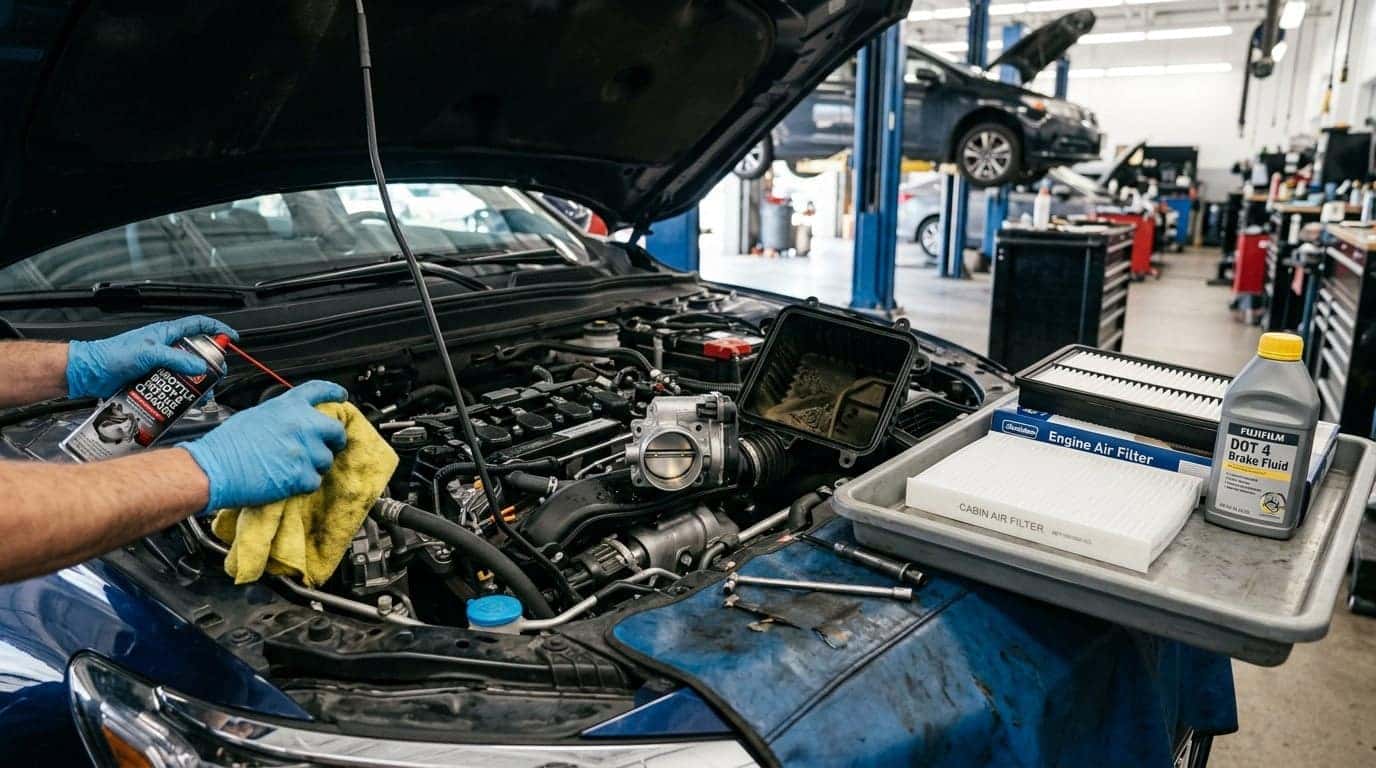
During a comprehensive vehicle service, technicians clean critical engine, braking, fuel, and electrical components to maintain performance, fuel economy, and driving safety. Standard component cleaning covers the throttle body intake bore, mass air flow sensor, fuel injectors, intake valves, battery terminals, brake caliper slide pins and rotors, HVAC cabin air channels, and underbody chassis assemblies. Performing targeted cleaning removes carbon soot, road salt, dust, and oil buildup before these contaminants trigger engine misfires, erratic idling, or component corrosion.
When a vehicle undergoes complete preventive care, servicing extends far beyond changing fluids and filters. Dust, unburned fuel residue, and atmospheric grime constantly accumulate inside dark underhood passages and mechanical friction points. Over time, these deposits restrict airflow, insulate heat, and cause moving parts to bind. A thorough cleaning protocol restores precise tolerances across several major automotive systems:
- Intake and Air Management: Technicians clear varnish and carbon soot from the throttle plate, air box housing, and intake runners. Cleaning the mass air flow sensor removes fine dust film from the delicate sensing wire.
- Fuel and Combustion System: Fuel injector tips and intake valves undergo specialized cleaning to eliminate spray-pattern restrictions and heavy carbon buildup that absorbs liquid fuel.
- Electrical and Ignition Systems: Corrosive white and green oxidation is removed from battery posts, cable terminals, and primary chassis ground wires to preserve electrical current flow.
- Braking and Undercarriage: Brake calipers, slide pins, and rotor faces are cleared of metallic brake dust and road grime. Following winter driving on treated roads, thorough underbody flushing washes away road salt from frame rails, fuel lines, and exhaust heat shields.
For local commuters driving daily along Nashville Pike or rural corridors, keeping these components free of grime ensures predictable starting and smooth power delivery in every season. If you are experiencing unusual engine surging or soft pedal feel, feel free to give our service department a call at (615) 442-3090 for expert maintenance guidance, or visit our Gallatin service center address at 1461 Nashville Pike, Gallatin, TN 37066 to have our certified technicians inspect your vehicle.
Table of Contents
- What Is the Typical Cost and Process of Throttle Body Cleaning?
- Why Is Mass Air Flow Sensor Cleaning Essential for Engine Performance?
- Chemical Fuel Injection Cleaning vs. Manual Valve Carbon Cleaning
- What Components Are Inspected and Cleaned During EV Maintenance?
- DIY vs. Professional Service: Should You Clean Engine Components Yourself?
- Frequently Asked Questions About Vehicle Cleaning Services and Longevity ROI
What Is the Typical Cost and Process of Throttle Body Cleaning?
A professional throttle body cleaning service generally costs between $80 and $150 in technician labor and specialized cleaning solvents. The cleaning process involves removing the intake ducting, applying dedicated aerosol solvent to the throttle plate and internal bore, and manually wiping away carbon soot and varnish to restore correct air clearance and smooth idle control.
The throttle body acts as the primary air gate for your internal combustion engine. Every time you press the accelerator pedal, a butterfly valve rotates to let measured air enter the intake manifold. Over thousands of miles, oil vapors from the crankcase ventilation system mix with microscopic dirt particles, creating a sticky black coating around the edges of the throttle plate. This narrowing of the air gap restricts initial airflow, leading to stalled starts, fluctuating idle speeds, and delayed throttle response.
During a professional service, technicians inspect the electronic motor housing and spray specialized, sensor-safe throttle cleaner onto a lint-free cloth or directly onto the throttle bore. Using soft brushes, they gently scrub away hardened carbon deposits without scratching the machined aluminum walls or damaging protective internal coatings. On modern vehicles equipped with electronic drive-by-wire throttles, the engine control module often requires an idle air volume relearn procedure after cleaning. This diagnostic reset recalibrates the computer to the expanded, clean airflow gap, stabilizing idle RPM back to factory specification.
Maintaining clean intake components protects long-term vehicle value, whether you drive a newer model or are maintaining our selection of quality pre-owned vehicles for daily travel. For example, vehicles like the 2026 Nissan Rogue feature a 1.5L engine with an MSRP starting at $33,340 for the Dark Armor trim (with a $1,575 destination charge) or $34,740 for Dark Armor AWD, where precise intake airflow control helps maintain smooth power delivery through the Xtronic transmission.
Pricing
Pricing by trim
| Feature | Dark Armor | Dark Armor AWD | Platinum AWD | Rock Creek AWD |
|---|---|---|---|---|
| Base MSRP | $33,340 | $34,740 | $39,390 | $34,390 |
| Destination charge | $1,575 | $1,575 | $1,575 | $1,575 |
Pricing (continued)
| Feature | S AWD | S FWD | SL AWD | SL FWD |
|---|---|---|---|---|
| Base MSRP | $30,890 | $29,490 | $36,990 | $35,590 |
| Destination charge | $1,575 | $1,575 | $1,495 | $1,495 |
Pricing (continued)
| Feature | SV AWD | SV FWD |
|---|---|---|
| Base MSRP | $31,890 | $30,490 |
| Destination charge | $1,575 | $1,575 |
Engine & Performance
Powertrain specs by trim
| Feature | Dark Armor | Dark Armor AWD | Platinum AWD | Rock Creek AWD |
|---|---|---|---|---|
| Engine | 1.5L | 1.5L | 1.5L | 1.5L |
| Horsepower | 201 hp | 201 hp | 201 hp | 201 hp |
| Torque | 225 lb-ft | 225 lb-ft | 225 lb-ft | 225 lb-ft |
| Transmission | Xtronic | Xtronic | Xtronic | Xtronic |
| Drivetrain | Front-wheel drive | All-wheel drive | All-wheel drive | All-wheel drive |
Engine & Performance (continued)
| Feature | S AWD | S FWD | SL AWD | SL FWD |
|---|---|---|---|---|
| Engine | 1.5L | 1.5L | 1.5L | 1.5L |
| Horsepower | 201 hp | 201 hp | 201 hp | 201 hp |
| Torque | 225 lb-ft | 225 lb-ft | 225 lb-ft | 225 lb-ft |
| Transmission | Xtronic | Xtronic | Xtronic | Xtronic |
| Drivetrain | All-wheel drive | Front-wheel drive | All-wheel drive | Front-wheel drive |
Engine & Performance (continued)
| Feature | SV AWD | SV FWD |
|---|---|---|
| Engine | 1.5L | 1.5L |
| Horsepower | 201 hp | 201 hp |
| Torque | 225 lb-ft | 225 lb-ft |
| Transmission | Xtronic | Xtronic |
| Drivetrain | All-wheel drive | Front-wheel drive |
Why Is Mass Air Flow Sensor Cleaning Essential for Engine Performance?
Mass air flow sensor cleaning is essential because a clean sensing wire provides exact air mass calculations to the engine control unit, ensuring correct fuel metering and optimum combustion efficiency. Cleaning the sensor with a zero-residue aerosol solvent removes microscopic oil films and dust crusts that otherwise cause false lean readings, engine hesitation, sluggish acceleration, and reduced gas mileage.
Positioned between the air filter box and the throttle body, the mass air flow sensor uses a tiny heated wire element to measure the weight of air entering the engine. As intake air flows across this wire, it cools the element. The engine computer measures how much electrical current is needed to keep the wire at a constant temperature, using that data to calculate air density and inject the exact amount of fuel required.
In dusty driving conditions around Cross Plains, fine dirt particles and oil vapor from cleanable performance air filters can bypass the air filter and coat the sensor element. Even a microscopic layer of contamination insulates the wire, delaying its cooling rate. When the computer receives inaccurate low-air signals, it injects less fuel than the engine actually needs. This lean air-fuel condition manifests as:
- Engine hesitation or stumble during mild acceleration
- Rough, erratic idling when stopped at traffic lights
- Illuminated check engine lights indicating lean fuel trim diagnostic codes
- Increased fuel consumption as the computer attempts inconsistent feedback corrections
Cleaning the sensor takes only minutes during routine service, but requires precise care. Technicians spray a dedicated, fast-evaporating cleaner designed specifically for delicate electronic sensors. Solvent cleaners formulated for general carburetors or brakes should never be used, as harsh chemicals can strip protective coatings or shatter the fragile platinum wire. Keeping your air intake sensors clean helps maintain smooth performance whether you are evaluating trade-in options or learning why drivers choose our dealership for long-term vehicle care. Owners preparing to upgrade can also value your trade-in online to see how routine maintenance supports strong resale value.
The 2026 Nissan Rogue lineup illustrates how modern engine design relies on precise air measurement. Powered by a 1.5L engine producing 201 hp and 225 lb-ft of torque paired with an Xtronic transmission, models ranging from S FWD with a base MSRP of $29,490 and $1,575 destination, SV FWD at $30,490, SL FWD at $35,590, up to Platinum AWD at $39,390 depend on accurate air metering to deliver responsive power across both front-wheel drive and all-wheel drive configurations.
Chemical Fuel Injection Cleaning vs. Manual Valve Carbon Cleaning
Chemical fuel injection cleaning circulates concentrated liquid solvents through running fuel injectors to dissolve soft varnish and light carbon, whereas manual valve carbon cleaning physically removes heavy, baked-on deposits from intake valves using media blasting or manual scraping. Chemical service acts as preventive maintenance for fuel delivery channels, while manual cleaning is an intensive restoration process required when heavy carbon restricts mechanical airflow.
Engine designs treat fuel delivery in two distinct ways: port fuel injection and gasoline direct injection. Understanding the difference explains why cleaning methods vary significantly:
| Cleaning Method | Primary Target Area | Deposit Type Removed | Service Complexity | Ideal Maintenance Role |
|---|---|---|---|---|
| Chemical Fuel Cleaning | Injector nozzles, fuel rail, combustion chamber | Soft fuel varnish, wet gum, light carbon | Low to Moderate (Pressurized canister hookup) | Preventive service every 15,000 to 30,000 miles |
| Manual Carbon Cleaning | Intake valve stems, port walls, intake runner ports | Hard, baked-on crust, dry carbon, oil sludge | High (Requires intake manifold removal) | Restorative repair when misfires or air restriction occur |
In port-injected systems, chemical cleaners sprayed into the fuel rail wash directly over the backside of the intake valves, keeping them clean during daily driving. However, modern direct-injection engines spray fuel directly into the combustion cylinder. While this improves fuel efficiency and power, gasoline no longer sprays over the intake valves to wash away crankcase oil vapors. Over time, these oil mist deposits bake onto hot intake valves, forming a hard carbon crust that chemical additives cannot dissolve.
When carbon accumulation restricts valve movement and chokes air intake ports, manual cleaning becomes necessary. Technicians remove the intake manifold, seal off the engine cylinders, and use specialized equipment to blast crushed walnut shell media into the intake ports. The abrasive action strips away rock-hard carbon without damaging the softer aluminum engine head.
Commuters managing daily highway driving along regional routes around Portland benefit from staying ahead of fuel system maintenance before heavy carbon forms. Keeping maintenance costs predictable makes vehicle ownership simpler, allowing families to participate in community initiatives like our annual high school car giveaway with peace of mind. For those planning a vehicle purchase or routine service budget, drivers can apply for vehicle financing online to explore clear payment options.
What Components Are Inspected and Cleaned During EV Maintenance?
Electric vehicle scheduled maintenance focuses on cleaning brake caliper slide pins and pad hardware, clearing debris from high-voltage thermal radiator fins, and flushing thermal management battery coolant. Because EV regenerative braking handles most stopping force, mechanical friction brakes see less frequent use, making routine brake assembly cleaning critical to prevent rust, pin seizure, and pad binding.
While electric vehicles eliminate engine oil, spark plugs, and exhaust systems, their specialized high-voltage components and chassis running gear still require routine cleaning and care:
- Regenerative and Friction Brake Assemblies: During normal deceleration, the electric motor slows the vehicle while recharging the battery. Because the hydraulic disc brakes engage far less often, moisture and road dirt sit on rotor faces and inside caliper pin boots. Without routine disassembly, cleaning, and lubrication, brake slide pins seize, leading to uneven pad wear and drag.
- High-Voltage Thermal Radiators and Chillers: Battery packs operate within strict temperature windows. Heat exchangers mounted at the front of the vehicle accumulate leaves, insects, and road grime that block cooling air. Cleaning these cooling fins prevents thermal throttling during fast charging or heavy summer driving.
- Battery Terminals and Ground Straps: Low-voltage 12-volt auxiliary batteries power vehicle electronics and control computers. Cleaning 12V terminal posts stops corrosion that could otherwise disrupt power to high-voltage relays.
- Undercarriage Battery Enclosures: Road salt and dirt collect around battery tray mounting points and aluminum skid plates. Rinsing these areas protects protective coatings and prevents localized corrosion.
Staying current with EV preventive care protects high-voltage efficiency and extends component life. Owners can easily order genuine OEM parts online for routine maintenance items, or contact our service department to schedule a battery health inspection to keep all electrical systems performing reliably.
DIY vs. Professional Service: Should You Clean Engine Components Yourself?
Simple maintenance tasks such as spraying a mass air flow sensor or clearing dry debris from an air filter housing can be done safely at home using dedicated aerosol solvents, whereas complex services like intake valve carbon blasting, electronic throttle relearns, and brake caliper disassembly are best handled by professional technicians. Attempting advanced component cleaning without professional tools risks damaging sensitive electronics, scratching machined surfaces, or creating lean air leaks.
Evaluating whether to clean engine parts yourself comes down to tools, chemical safety, and electronic calibration requirements:
- Safe DIY Cleaning Tasks: Removing an air intake boot to spray mass air flow sensor cleaner onto an exposed sensing wire is straightforward. Inspecting and wiping dry leaf debris from the air filter box or cleaning surface corrosion from accessible 12-volt battery terminals with a baking soda wash requires basic hand tools and minimal risk.
- Tasks Requiring Professional Service: Cleaning an electronic throttle body on modern vehicles often requires electronic diagnostic tools to perform an idle relearn reset. If cleaned manually without care, forcing an electronic throttle plate open can strip internal plastic servo gears. Similarly, chemical fuel flushing under high pressure or manual valve media blasting requires intake manifold removal, cylinder positioning knowledge, and specialized high-pressure flush canisters.
Our service advisors frequently see drivers asking whether a dirty air sensor or throttle plate is causing a subtle hesitation during morning starts. When DIY cleaning falls short or diagnostic warning lights appear, professional service ensures components are cleaned thoroughly, seals are replaced correctly, and engine control computers are properly recalibrated.
Frequently Asked Questions About Vehicle Cleaning Services and Longevity ROI
Q: How often should a vehicle throttle body be cleaned?
A: A throttle body generally requires professional inspection and cleaning every 30,000 to 50,000 miles, or sooner if you experience rough idling, engine stalling, or delayed accelerator response. Vehicles driven frequently in heavy stop-and-go traffic or dusty conditions build up carbon soot more rapidly around the throttle plate. Routine cleaning during major service intervals maintains smooth airflow and prevents erratic idle speeds.
Q: Can cleaning engine components improve fuel economy?
A: Yes, cleaning intake and fuel components restores lost fuel efficiency by ensuring accurate air-fuel mixing and proper fuel atomization. Removing carbon from throttle plates and mass air flow sensors allows the engine computer to meter fuel precisely, while cleaning dirty fuel injectors restores an even spray pattern. Restoring these components to clean operating condition eliminates wasteful rich running conditions and engine hesitation.
Q: What is the risk of using the wrong chemical cleaner on engine sensors?
A: Using harsh solvents like standard brake cleaner or carburetor sprays on mass air flow sensors or electronic throttle bodies can permanently ruin delicate electronics and dissolve protective internal coatings. Sensor-safe aerosol cleaners are specially formulated to evaporate completely without leaving residue or stripping delicate wire elements. Using non-approved chemicals often leads to sensor failure and immediate check engine light warnings.
Q: Why do direct-injection engines require carbon cleaning more often than port-injected engines?
A: Direct-injection engines inject fuel straight into the combustion chamber rather than into the intake runner, meaning gasoline never flows across the back of the intake valves to wash away crankcase oil mist. Over time, these oil vapors bake onto hot intake valves, forming a dense carbon crust that restricts intake airflow. Manual carbon cleaning or media blasting physically removes this hard crust to restore lost engine horsepower.
Q: Is underbody cleaning necessary after driving in winter conditions?
A: Thoroughly flushing the vehicle underbody with fresh water after winter weather removes corrosive road salt and chemical de-icers that settle on metal frame rails, brake lines, fuel lines, and exhaust heat shields. Rinsing away salt crust prevents rust formation on vulnerable steel and aluminum components, protecting structural integrity and long-term chassis durability.
Keeping your vehicle running smoothly requires consistent care and expert component maintenance. If your vehicle is due for intake cleaning, fuel system care, or a comprehensive multi-point inspection, our factory-trained service team is ready to help. You can call our service desk at (615) 442-3090 to speak directly with an advisor, or get directions to our Gallatin location to stop by in person. If you are considering an upgrade to a reliable new vehicle, take a moment to explore our new Nissan inventory online today to find the perfect match for your driving needs.
0 comment(s) so far on What Technical Components Are Cleaned During a Full Car Service?