

How Often Should You Change Your Car Oil?
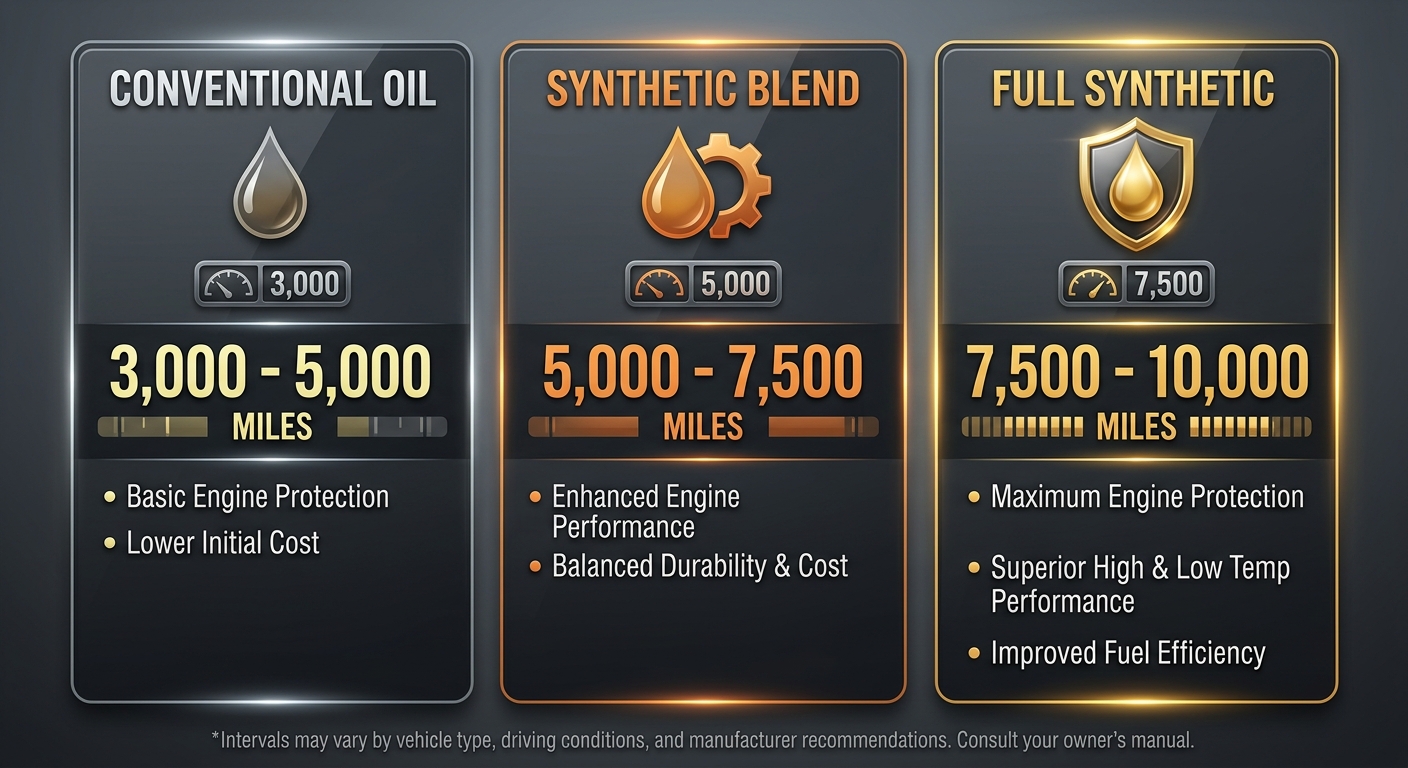
Most modern vehicles running full synthetic oil require an oil change every 7,500 to 10,000 miles or every 12 months, while vehicles using conventional oil need service every 3,000 to 5,000 miles or 6 months. Following your vehicle manufacturer’s specified interval prevents oil degradation and protects vital internal components from severe friction.
| Oil Type | Standard Mileage | Time Interval |
|---|---|---|
| Conventional | 3,000 – 5,000 mi | 6 months |
| Synthetic Blend | 5,000 – 7,500 mi | 6 to 9 months |
| Full Synthetic | 7,500 – 10,000 mi | 12 months |
While these baseline figures provide a solid guide, driving habits directly impact how quickly motor oil breaks down. Severe driving conditions accelerate oil contamination, requiring more frequent maintenance. Industry standards define severe driving as:
- Frequent short trips under 5 miles in normal weather or under 10 miles in freezing conditions
- Stop-and-go driving in heavy commuter traffic or prolonged engine idling
- Towing trailers, carrying heavy cargo loads, or driving in dusty, rough rural terrain
- Sustained driving in extreme summer heat or sub-freezing winter weather
For instance, Portland commuters making daily highway runs toward metropolitan traffic often subject their engines to higher operating heat and frequent idling. Under these conditions, servicing your vehicle closer to the 5,000-mile mark helps maintain engine efficiency and protects your investment.
When you need routine engine service, you can easily get directions to our Gallatin location or give our service team a quick call to check your maintenance schedule.
Table of Contents
- What Does Engine Oil Actually Do Inside a Vehicle?
- How Does Engine Oil Control Heat and Regulate Operating Temperature?
- Does Motor Oil Clean Internal Components and Prevent Corrosion?
- What Is the Specific Role of the Oil Filter in Engine Protection?
- What Are the Different Types of Motor Oil and Why Do Modern Engines Require Synthetic?
- Can You Switch From Synthetic Back to Conventional Oil or Choose a Blend?
- Common Questions About Engine Oil Care and Service Intervals
- Schedule Professional Nissan Maintenance
What Does Engine Oil Actually Do Inside a Vehicle?
Engine oil forms a continuous protective liquid barrier between high-speed metal components to eliminate direct friction and prevent mechanical wear. Beyond reducing friction, it absorbs heat, removes combustion debris, and shields internal surfaces from moisture and rust.
Inside your engine, pistons move up and down thousands of times per minute while crankshafts and camshafts rotate rapidly. Without proper lubrication, these metal surfaces grind against one another, creating intense friction and extreme heat that can weld components together within seconds. Motor oil circulates under pressure through precise oil galleries, coating every rotating shaft, valve stem, and cylinder wall with a micron-thin film.
Motor oil performs four critical jobs every time your engine runs:
- Lubrication: Creates a hydrodynamic cushion between moving metal parts to eliminate direct contact.
- Temperature Control: Absorbs intense heat from pistons and bearings, transferring it safely to the oil pan.
- Internal Cleaning: Sweeps away microscopic carbon soot, metal dust, and combustion byproducts.
- Corrosion Defense: Neutralizes moisture and acidic gases formed during fuel combustion to protect steel and aluminum surfaces.
Whether you are exploring our new Nissan vehicle lineup or checking out our quality pre-owned inventory options, keeping fresh oil in the crankcase ensures your vehicle delivers dependable performance and optimal fuel savings over its entire lifespan.
How Does Engine Oil Control Heat and Regulate Operating Temperature?
Engine oil manages up to 40% of an engine’s internal cooling demands by absorbing intense thermal energy directly from pistons and bearings where liquid coolant cannot reach. It circulates that heat away from the combustion chamber down to the oil pan to dissipate before recirculating.
While your engine radiator circulates liquid coolant through the outer engine block, internal components like piston crowns and connecting rod bearings rely entirely on motor oil for cooling. Combustion temperatures inside cylinder chambers reach over 1,500 degrees Fahrenheit. As oil splashes against the underside of hot pistons, it conducts extreme heat away from critical metal surfaces.
When oil grows old or runs low, its thermal transfer capacity drops dramatically. Degraded oil thins out under heat, causing the protective film to rupture. This breakdown leads to hot spots, increased internal drag, and elevated engine temperatures.
Cross Plains drivers pulling trailers or carrying heavy farm cargo across rolling terrain put extra thermal load on their powertrains, making heat management via fresh motor oil essential for preventing thermal stress. If you are considering upgrading to a vehicle built for heavier demands, our team can help you value your trade-in online in just a few minutes.
Does Motor Oil Clean Internal Components and Prevent Corrosion?
Motor oil uses active detergent and dispersant additives to capture microscopic carbon deposits, varnish, and metallic dust before neutralizing acidic combustion byproducts. This chemical cleaning action suspends contaminants in liquid form so they are swept into the filter rather than baking onto internal surfaces as harmful sludge.
Every time gasoline or diesel burns inside an engine, small amounts of unburned fuel, water vapor, soot, and sulfur compounds blow past the piston rings into the crankcase. Fresh oil contains detergent compounds that scrub varnish off hot metal surfaces and dispersants that prevent tiny particles from clumping together.
| Contaminant Type | Source in Engine | How Oil Protects |
|---|---|---|
| Carbon Soot | Incomplete fuel combustion | Dispersants suspend particles |
| Water & Moisture | Humidity & blow-by condensation | Anti-corrosion inhibitors neutral |
| Acidic Byproducts | Combustion gases mixing with H2O | Alkaline additives neutralize acid |
| Metal Micro-shavings | Normal mechanical friction | Detergents carry debris to filter |
When oil changes are delayed, these protective additives become depleted. Contaminants settle into low-flow areas of the engine, forming a thick, black sludge that clogs oil passages and starves critical components of oil pressure. Over time, trapped moisture mixes with combustion gases to form acids that pit metal surfaces.
To keep your powertrain clean, you can order OEM oil filters online directly through our parts center. If you are planning broader maintenance or vehicle upgrades, you can also submit a financing application online to explore flexible payment arrangements.
What Is the Specific Role of the Oil Filter in Engine Protection?
The oil filter acts as the primary mechanical barrier in the lubrication system, trapping soot, dirt, and microscopic metal shavings down to roughly 20 microns before oil recirculates. Replacing the filter with every oil change prevents trapped debris from bypassing the filter media and scouring cylinder walls.
As motor oil circulates through the engine, it pumps directly through the synthetic or cellulose fibers of the oil filter. The filter media captures abrasive particles that would otherwise act like fine sandpaper against precision bearings and camshaft lobes.
Oil filters feature key structural elements that preserve engine health:
- Anti-Drainback Valve: Holds oil inside the filter when the engine is turned off, preventing dry starts.
- Bypass Relief Valve: Opens during extreme cold starts or when the filter is clogged, keeping oil flowing to prevent immediate engine seizure.
- High-Efficiency Media: Traps harmful contaminants while maintaining consistent oil pressure across varying temperatures.
Leaving an old filter on during an oil change contaminates fresh fluid immediately. Furthermore, a dirty filter can saturate completely, forcing the bypass valve open and circulating unfiltered dirty oil back through your engine. Replacing the filter at every service interval guarantees clean fluid circulation.
What Are the Different Types of Motor Oil and Why Do Modern Engines Require Synthetic?
Modern high-efficiency engines require full synthetic motor oil because chemically engineered synthetic molecules maintain uniform viscosity and resist breakdown under the high heat and tight tolerances of turbocharged powertrains. Conventional crude-based oils degrade faster under thermal stress, while synthetic blends offer intermediate protection.
| Oil Type | Base Material | Key Benefits |
|---|---|---|
| Conventional | Refined crude mineral oil | Low cost, basic protection |
| Synthetic Blend | Mixture of mineral & synthetic | Better heat defense, moderate cost |
| Full Synthetic | Chemically synthesized base | Superior heat stability, long life |
| High-Mileage | Synthetic or blend + seal guards | Conditioners for engines over 75k mi |
Engine designs have evolved rapidly over recent years. Today’s engines use lightweight viscosity grades like 0W-20 full synthetic or 0W-16 full synthetic oil to maximize fuel economy and provide instant flow upon starting. Turbochargers, direct injection, and variable valve timing rely on clean, ultra-consistent oil flow through oil passages as narrow as a needle tip.
Full synthetic oil provides major performance upgrades over mineral-based oils:
- Thermal Resistance: Resists oxidation and breakdown at temperatures exceeding 400 degrees Fahrenheit.
- Low-Temperature Flow: Pumps easily during freezing winter starts to eliminate metal scraping.
- Sludge Prevention: Resists chemical degradation, keeping internal engine components varnish-free.
When commuters visit our service center, they often ask whether running synthetic oil means they can safely stretch service past 10,000 miles. We advise keeping to manufacturer schedules because engine oil still accumulates fuel blow-by and dirt regardless of oil type. You can learn more about why drivers choose Newton Nissan of Gallatin for complete vehicle care and warranty protection.
Can You Switch From Synthetic Back to Conventional Oil or Choose a Blend?
You can safely switch between full synthetic, synthetic blend, and conventional motor oils without damaging your engine, provided the chosen oil satisfies the minimum viscosity grade and manufacturer specifications listed in your owner’s manual. However, dropping to conventional oil in an engine designed specifically for full synthetic can trigger accelerated wear and void warranty coverage.
A persistent automotive myth claims that once an engine runs on synthetic oil, returning to conventional oil causes leaks or seal damage. Modern motor oils are completely compatible with one another and use standardized synthetic and mineral base stocks.
When choosing between oil formulations, keep these practical rules in mind:
- Factory Requirements First: If your owner’s manual specifies full synthetic oil, never downgrade to conventional fluid.
- High-Mileage Powertrains: For vehicles with over 75,000 miles, switching to a high-mileage synthetic blend helps soften older rubber seals to prevent oil drops.
- Seasonal Flexibility: You can upgrade to full synthetic during cold winter months for faster engine starts, then run a blend during temperate spring weather if permitted by your manual.
Consistently using oil that meets or exceeds factory specifications preserves your powertrain and helps keep your vehicle Safe, Smart, and Ready for Your Gallatin Commute.
Common Questions About Engine Oil Care and Service Intervals
Q: How do I accurately check my car’s oil level and condition at home?
Park your vehicle on a flat surface, turn off the engine, and wait roughly ten minutes for oil to drain into the pan. Pull the dipstick out, wipe it clean with a rag, reinsert it fully, and pull it out again to observe the oil level between the minimum and maximum indicator marks. Fresh oil appears clear and amber, while dark, gritty oil filled with debris indicates it is time to schedule a change.
Q: What happens if I accidentally overfill my engine with motor oil?
Overfilling crankcase oil causes the rotating crankshaft to whip fluid into a thick foam filled with air bubbles. Aerated oil cannot build proper hydraulic pressure, leaving bearings and camshafts without adequate lubrication while increasing internal pressure that can blow out engine seals. If the oil dipstick shows a level well above the full mark, excess oil must be drained before driving.
Q: Does an automatic oil life monitor mean I can skip checking the dipstick?
Oil life monitors use algorithms based on engine revolutions, operating temperatures, and mileage to estimate oil degradation, but they do not measure actual fluid level or physical cleanliness. Leaks or natural oil consumption can cause fluid levels to drop dangerously low without triggering an oil life warning light. Checking the dipstick manually at least once a month ensures your engine never runs low on fluid.
Q: Why does my car oil turn dark brown or black shortly after a service?
Motor oil naturally darkens as detergent additives scrub lingering carbon deposits and soot from internal engine walls. Dark oil simply proves that dispersant additives are doing their job by keeping particles suspended rather than allowing them to bake onto metal surfaces as sludge. Color alone does not mean the oil is degraded, provided you follow recommended mileage intervals.
Q: Will skipping a scheduled oil change void my vehicle’s factory warranty?
Neglecting recommended oil changes can jeopardize engine claims under your 5-year/60,000-mile powertrain warranty if mechanical failure results from oil breakdown or sludge. Vehicle manufacturers require proof of regular maintenance according to factory intervals to validate warranty repairs. Keeping detailed service receipts protects your warranty coverage and supports long-term resale value.
To support local families and students, our dealership takes pride in community initiatives like the Newton Nissan High School Car Giveaway. You can explore complete service details and local vehicle support through our local Nissan dealership resource hub.
Schedule Professional Nissan Maintenance
Keeping up with routine oil changes is the single most effective action you can take to protect your vehicle’s engine, preserve optimal fuel economy, and enjoy lasting peace of mind on every journey. Fresh oil ensures your powertrain delivers smooth performance, whether you are running quick errands or driving long highway miles.
Our factory-trained technicians at Newton Nissan of Gallatin provide thorough maintenance using genuine OEM oil filters and factory-approved synthetic oils. Every service visit includes a multi-point inspection to check fluid levels, belt wear, and tire condition so you can drive away with complete confidence.
Take the next step in caring for your vehicle today:
- Get directions to Newton Nissan of Gallatin to visit our dedicated service department.
- Give our service advisors a quick call at (615) 442-3090 to reserve your upcoming maintenance appointment.
0 comment(s) so far on How Often Should You Change Your Car Oil?