

How Tire Alignment and Balancing Directly Affect Fuel Efficiency
How Tire Alignment and Balancing Directly Affect Fuel Efficiency
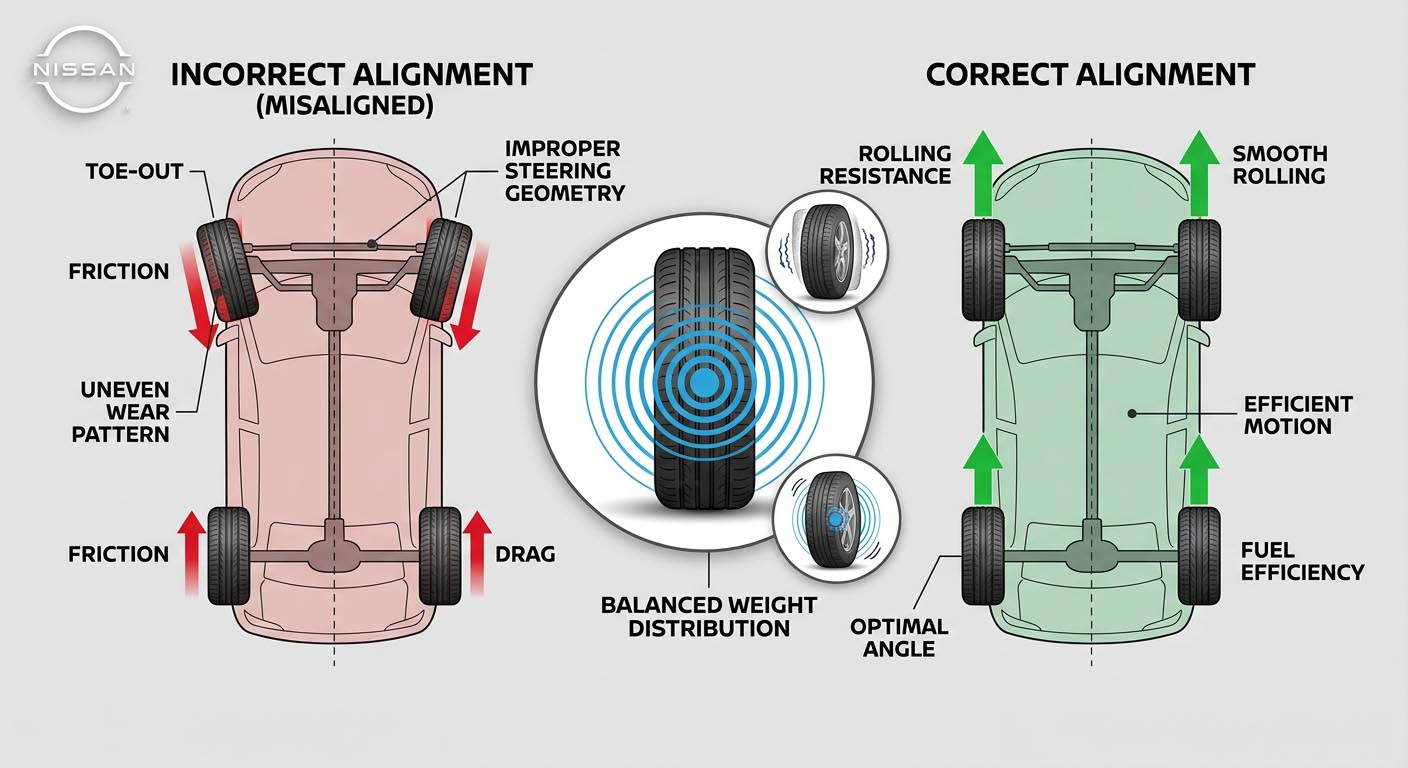
When your vehicle is out of alignment, your tires do not point in the exact direction intended by the manufacturer. Instead of rolling smoothly down the pavement, one or more tires drag slightly sideways. This creates a mechanical drag known as rolling resistance, which forces your engine to burn extra fuel simply to maintain highway speeds. When you multiply this resistance across thousands of miles of driving, the impact on your wallet becomes highly noticeable.
Proper tire alignment and wheel balancing work together to eliminate this unnecessary friction. Alignment ensures that all four wheels point in the same direction, allowing the tread to meet the road at the optimal angle. Balancing guarantees that the weight of the wheel and tire assembly is distributed evenly around the axle, preventing the microscopic hopping and tire wobble that also wastes kinetic energy.
Addressing these issues directly reduces the workload on your powertrain. If you suspect your vehicle is fighting against its own suspension geometry, you can easily get in touch with our service team by calling (615) 442-3090 to discuss your vehicle’s current performance. For drivers ready to bring their vehicle in for an inspection, dropping by our Gallatin service center is the quickest way to have our factory-trained technicians measure your wheel angles on a precision alignment rack.
Table of Contents
- Calculating Real-World Gas Savings from Proper Alignment
- The Technical Difference Between Wheel Alignment and Tire Balancing
- Identifying Symptoms of Poor Alignment on Rural Roads
- How Misalignment Accelerates Tire Wear on Tough Rural Routes
- Common Questions About Tire Maintenance and Fuel Savings
- Get Expert Tire Service and Alignment
Calculating Real-World Gas Savings from Proper Alignment
How much can you actually expect to save on fuel by keeping your wheels properly aligned? According to automotive industry studies, a vehicle with severely misaligned tires can experience a drop in fuel economy of up to 10 percent. For a commuter driving a highly efficient vehicle, this penalty quickly adds up to a substantial amount of wasted money over the course of a year.
Consider the 2026 Nissan Rogue as a practical example. A standard front-wheel-drive Rogue model, such as the SV trim, features a 1.5L engine paired with an Xtronic CVT that delivers an EPA-estimated 29 city / 36 hwy / 32 combined MPG. If a 10 percent fuel economy penalty is applied due to bad alignment, that combined average drops to roughly 28.8 MPG. For a driver covering 15,000 miles annually, that single misalignment issue forces the purchase of approximately 41 additional gallons of gasoline per year.
If you prefer to bypass gasoline entirely, keeping a vehicle aligned is just as critical for preserving battery range. For instance, drivers can explore our new Nissan Leaf inventory to see how an all-electric model benefits from reduced rolling resistance, maximizing every kilowatt-hour of charge. Those looking for highly efficient traditional options can also browse our affordable used cars or look into our new Nissan Kicks Play inventory to find a compact crossover that keeps fuel costs low.
Fuel Economy
Fuel economy and range by trim
| Feature | Dark Armor | Platinum | Rock Creek | S | SL | SV |
|---|---|---|---|---|---|---|
| MPG | 29 city / 36 hwy / 32 combined | 28 city / 35 hwy / 31 combined | 27 city / 32 hwy / 29 combined | 29 city / 36 hwy / 32 combined | 29 city / 36 hwy / 32 combined | 29 city / 36 hwy / 32 combined |
The Technical Difference Between Wheel Alignment and Tire Balancing
Are wheel alignment and tire balancing the same thing? Many motorists use these terms interchangeably, but they are completely independent maintenance procedures. Wheel alignment is an adjustment of the vehicle’s suspension system—the mechanical connection between the vehicle and the wheels—rather than an adjustment of the tires themselves. Tire balancing, on the other hand, corrects weight distribution imbalances within the tire and wheel assemblies.
During a professional wheel alignment, a technician adjusts three primary angles:
- Camber: The inward or outward tilt of the tire when viewed from the front of the vehicle.
- Toe: The direction the tires point relative to the vehicle’s centerline, similar to pointing your toes inward or outward while walking.
- Caster: The angle of the steering axis when viewed from the side, which influences steering stability and self-centering.
In contrast, tire balancing utilizes a specialized machine to spin the wheel assembly, identifying heavy spots. The technician then attaches small, precise metal weights to the outer or inner rim to ensure the wheel spins perfectly true.
If you are noticing a rough ride or steering pull, you can browse our new cars online to compare models with the latest suspension technology, or shop our new Nissan vehicles to find a model equipped with advanced driver-assist systems that rely on a perfectly aligned chassis. If a sporty, agile drive is your priority, we invite you to look at our new Nissan Kicks inventory to experience how a crisp, properly aligned steering setup feels on a test drive.
Engine & Performance
Powertrain specs by trim
| Feature | Dark Armor | Platinum | Rock Creek | S | SL | SV |
|---|---|---|---|---|---|---|
| Engine | 1.5L | 1.5L | 1.5L | 1.5L | 1.5L | 1.5L |
| Horsepower | 201 hp | 201 hp | 201 hp | 201 hp | 201 hp | 201 hp |
| Torque | 225 lb-ft | 225 lb-ft | 225 lb-ft | 225 lb-ft | 225 lb-ft | 225 lb-ft |
| Transmission | Xtronic CVT | Xtronic CVT | Xtronic CVT | Xtronic CVT | Xtronic CVT | Xtronic CVT |
| Drivetrain | Front-wheel drive | All-wheel drive | All-wheel drive | Front-wheel drive | Front-wheel drive | Front-wheel drive |
Identifying Symptoms of Poor Alignment on Rural Roads
How do you know when your vehicle is ready for the alignment rack before it severely impacts your fuel economy? The rolling terrain and agricultural routes around Cross Plains often make alignment symptoms easier to spot. Because these country roads feature elevation changes and varying pavement quality, a vehicle with suspension issues will quickly show its hand through the steering wheel.
The most common warning sign is a distinct pull to one side of the road when you attempt to drive straight. If you have to maintain constant counter-pressure on the steering wheel on a flat road, your toe or camber angles are likely out of spec. Another clear indicator is an off-center steering wheel; if the Nissan logo on your steering pad is tilted while your vehicle is traveling in a straight line, the steering linkage is out of index.
Vibrations are another key symptom, though they point to a different culprit. A shaking sensation in the steering wheel or floorboards—especially at speeds above 50 mph—typically indicates that your wheels are out of balance rather than out of alignment. If you want to explore vehicles designed to handle daily commuting with maximum refinement, you can browse our new Nissan inventory to find the perfect match. For a smooth-riding sedan, you can shop our new Nissan Altima inventory, or for a robust family vehicle, shop our new Nissan Armada inventory to experience premium highway comfort.
How Misalignment Accelerates Tire Wear on Tough Rural Routes
When wheels are forced out of their factory-specified parameters, the tread wear on your tires accelerates dramatically. On the hilly terrain and farm-to-market roads around Westmoreland, tires are subjected to lateral scrubbing forces that can destroy a brand-new set of rubber in a matter of months. Instead of the tire rolling evenly across its contact patch, a misaligned wheel drags the tread sideways across the asphalt.
This scrubbing action causes distinct, abnormal wear patterns:
- Feathering: The tread blocks develop a smooth edge on one side and a sharp ridge on the other, usually caused by incorrect toe settings.
- One-Sided Wear: The inner or outer edge of the tire wears down much faster than the rest of the tread, a classic symptom of excessive camber.
- Cupping: Diagonal scalloped dips appear across the tread, which is most often a sign of worn suspension components or severely unbalanced wheels.
To protect your investment and prevent premature tire replacement, regular checks are essential. If you are ready to transition to a highly efficient vehicle that minimizes your operating costs, you can shop our new electric vehicles to enjoy zero-emissions driving. For those who need a rugged vehicle capable of tackling tough utility tasks, you can shop our new Nissan Frontier inventory to find a midsize truck built for demanding work. If you prefer a traditional sedan with exceptional highway manners, shop our new cars to find a vehicle that offers a quiet, balanced ride.
Common Questions About Tire Maintenance and Fuel Savings
Q: How often should I have my alignment checked?
We recommend having your wheel alignment checked every 6,000 to 12,000 miles, or at least once a year. However, if you hit a deep pothole, curb, or notice your vehicle pulling to one side, you should have it inspected immediately to prevent uneven tire wear and drop in fuel efficiency.
Q: Can I get my tires balanced without getting an alignment?
Yes, tire balancing and wheel alignment are completely separate services. You can balance your wheels to eliminate high-speed vibrations without adjusting the suspension angles, though performing both services together ensures the smoothest ride and the best protection for your tires.
Q: Does a standard tire rotation include an alignment or balancing?
A standard tire rotation simply moves the wheels to different positions on the vehicle to ensure even tread wear and does not automatically include balancing or alignment. While balancing is often performed during a tire rotation, an alignment is a distinct service that requires specialized diagnostic equipment.
Q: How do I know if my tires are out of balance or out of alignment?
If your vehicle physically pulls to the left or right, or if your steering wheel is crooked when driving straight, you need an alignment. If you feel a shaking or vibration in the steering wheel or seat at highway speeds, your wheels are likely out of balance.
Q: Where can I learn more about Newton Nissan of Gallatin’s service philosophy?
To understand our commitment to transparent service and customer satisfaction, you can learn about us and our dedicated team of technicians. We also invite you to learn about our certified pre-owned program to see how we inspect every vehicle’s tires, brakes, and alignment before it reaches our lot.
Get Expert Tire Service and Alignment
Maintaining proper tire alignment and balancing is one of the most effective ways to protect your vehicle, maximize your fuel economy, and ensure a safe ride. At Newton Nissan of Gallatin, our state-of-the-art service department is equipped with precision diagnostic alignment systems designed to restore your vehicle’s steering geometry to its exact factory specifications. Whether you are driving a commuter sedan or a spacious family SUV, our factory-certified technicians have the expertise to keep your vehicle running efficiently.
We service all makes and models, utilizing genuine OEM parts and approved procedures to guarantee lasting quality. If you are looking to upgrade your family’s daily drive to a highly capable three-row SUV, we encourage you to look at the 2026 Nissan Pathfinder, which features a 3.5L V6 engine producing 284 hp and 259 lb-ft of torque, offering a robust 6,000 lbs towing capacity on properly equipped trims. Alternatively, if you want to explore innovative hybrid technology, you can shop our new Nissan Rogue PHEV inventory to experience the perfect blend of electric efficiency and gas backup.
To schedule your next alignment check or tire balancing service, give our service team a quick call today. If you are ready to visit us for maintenance or to explore our current inventory, you can find our showroom and service center directions online to plan your trip. Let us help you keep your tires rolling smoothly and your fuel costs down.
Pricing
Pricing by trim
| Feature | Dark Armor | Platinum | Rock Creek | S | SL | SV |
|---|---|---|---|---|---|---|
| Base MSRP | $33,340 | $39,390 | $33,690 | $29,090 | $35,290 | $30,490 |
| Destination charge | $1,545 | $1,545 | $1,390 | $1,495 | $1,390 | $1,545 |
0 comment(s) so far on How Tire Alignment and Balancing Directly Affect Fuel Efficiency