

The Evolution of Nissan Direct Injection and the Challenge of Carbon Buildup
The Evolution of Nissan Direct Injection and the Challenge of Carbon Buildup
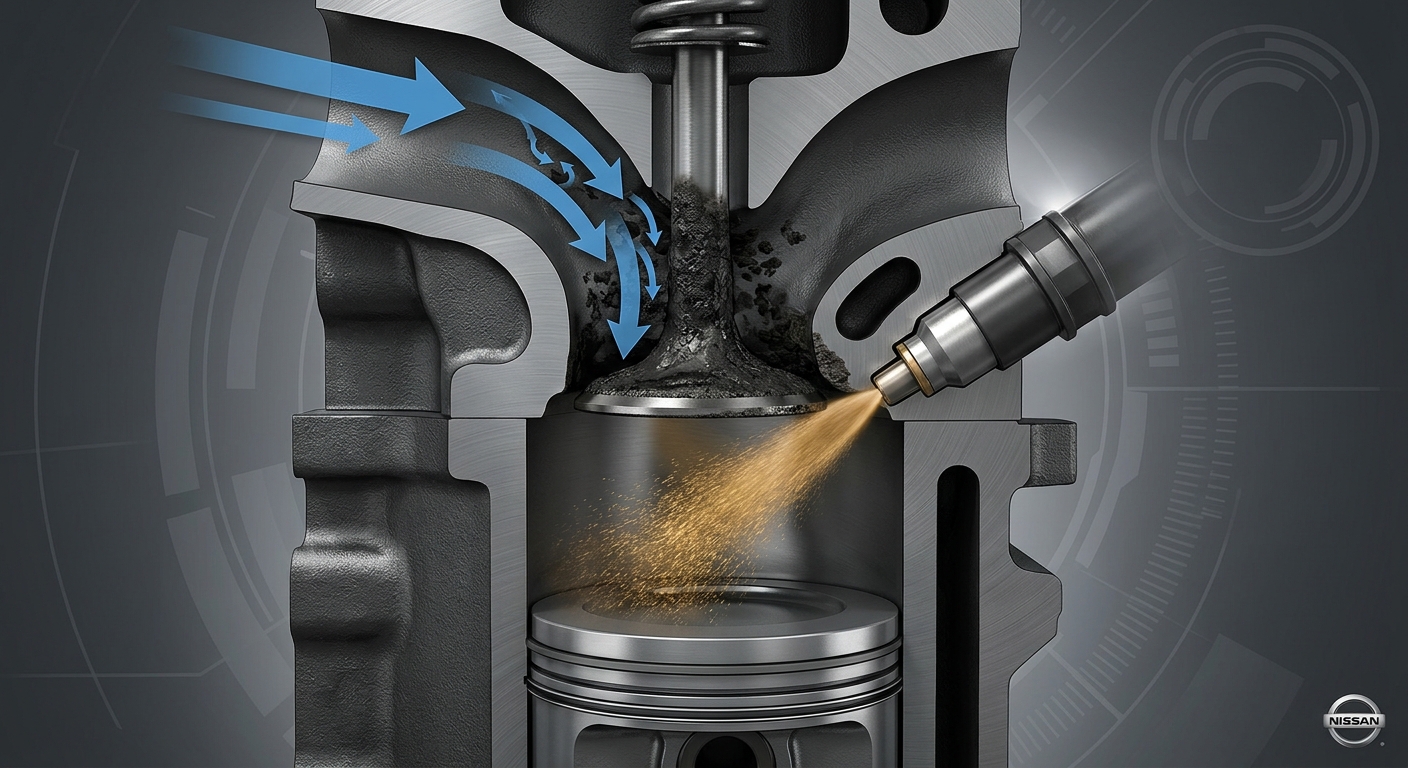
Modern automotive engineering relies heavily on efficiency and power, which led to the widespread adoption of Gasoline Direct Injection technology. In traditional port-injection systems, fuel was sprayed into the intake port, allowing the gasoline to wash over the back of the intake valves and naturally keep them clean. Today, advanced powerplants spray fuel directly into the combustion chamber under immense pressure. While this design significantly optimizes fuel atomization and power output, it creates a unique mechanical challenge: fuel no longer touches the back of the intake valves, leaving them vulnerable to rapid carbon accumulation.
Without the natural cleaning action of gasoline, oil vapors and combustion byproducts from the crankcase ventilation system bake onto the hot intake valves. Over time, these vapors solidify into heavy carbon deposits. This buildup restricts airflow into the cylinders, disrupting the precise air-fuel ratio required for optimal combustion. If left untreated, these deposits can hold the intake valves open longer than intended, allowing contaminants to slip back into the system and causing irregular engine performance.
For example, a driver navigating the rolling fields of Cross Plains might notice their engine struggling slightly when hauling supplies or climbing moderate elevations. This occurs because the vehicle’s direct-injection system lacks the natural cleaning action of port fuel injectors, allowing sticky carbon deposits to gradually choke off airflow. To prevent these performance bottlenecks, proactive maintenance is essential.
If you suspect your vehicle is experiencing these symptoms, you can contact our community automotive support team or reach our automotive service specialists for professional guidance. We provide comprehensive diagnostics for drivers utilizing our regional vehicle sales and services. Whether you are driving a model purchased from our pre-owned vehicle selection or want to learn about our annual high school vehicle giveaway, keeping your intake system clean is vital. You can also explore our nearby automotive care, speak with our dedicated team, or find resources through drivers in neighboring communities. For those closer to other areas, we support drivers in surrounding communities, coordinate with our surrounding service network, and offer our nearby maintenance options. Drivers seeking our regional vehicle support, our nearby vehicle solutions, or drivers in nearby areas can easily connect with us.
To experience our customer-focused care firsthand, you can find our physical dealership location online or get in touch with our service department directly by calling (615) 442-3090. We are proud to be our premier automotive showroom and our trusted Nissan dealership, serving the region as our local automotive dealership. From diagnostic checks to routine carbon cleaning, we help keep your vehicle running smoothly. If you reside in neighboring areas, you can also access our support near Westmoreland or our regional automotive experts, as well as our local maintenance center.
Table of Contents
- How a Professional BG GDI Fuel System Service Protects Your Engine
- Recognizing the Warning Signs of Carbon Deposits in Your Vehicle
- What Questions Should I Ask the Shop Before GDI Maintenance?
- Establishing the Right Maintenance Schedule for GDI Carbon Control
- Why Traditional Fuel Injection Flushes Cannot Solve GDI Carbon Buildup
- Common Questions About BG GDI Service and Nissan Performance
- Questions Drivers Ask About BG GDI Fuel System Care
- Schedule Professional Fuel System Care at Newton Nissan
How a Professional BG GDI Fuel System Service Protects Your Engine
Addressing carbon buildup requires a specialized approach because standard fuel additives poured into the gas tank cannot reach the back of the intake valves. A professional BG fuel system service utilizes specialized equipment to deliver high-strength chemical cleaners directly into the engine’s air intake tract. This process, often referred to as a chemical induction service, atomizes the cleaning agents so they can coat the intake valves, softening and dissolving the baked-on carbon deposits without requiring a complete engine teardown.
The treatment relies on two primary chemical stages to achieve complete carbon control. First, a professional-grade intake valve cleaner is introduced through the air intake to target the valve stems and ports. Second, a highly concentrated cleaner is run through the fuel rail to clean the tips of the direct-injection nozzles, which are subjected to extreme heat and pressure inside the combustion chamber. This dual-action method ensures that both the air delivery pathways and the fuel delivery nozzles are fully cleared of performance-robbing blockages.
As part of this comprehensive maintenance, a canister of BG 44K Fuel System Cleaner is added directly to the fuel tank. This product is formulated to clean the fuel pump, lines, and combustion chambers. Because it contains no alcohol, it is safe for catalytic converters and oxygen sensors, preventing the chemical degradation that lower-quality retail additives can cause. Utilizing this service regularly helps maintain proper fuel atomization and preserves the tight tolerances of your engine’s internal components.
Investing in preventative maintenance is highly cost-effective compared to the expensive mechanical repairs required once carbon deposits cause physical engine damage. For those driving older or high-mileage models, keeping the fuel system clean is the best way to extend the lifespan of your vehicle. If you are currently shopping for a reliable ride, you can browse our selection of affordable pre-owned models, look through our quality used vehicles under $30K, or find budget-friendly choices among our used inventory under $20K.
Engine & Performance
Powertrain specs by trim
| Feature | Dark Armor | Platinum | Rock Creek | S | SL | SV |
|---|---|---|---|---|---|---|
| Engine | 1.5L | 1.5L | 1.5L | 1.5L | 1.5L | 1.5L |
| Horsepower | 201 hp | 201 hp | 201 hp | 201 hp | 201 hp | 201 hp |
| Torque | 225 lb-ft | 225 lb-ft | 225 lb-ft | 225 lb-ft | 225 lb-ft | 225 lb-ft |
| Transmission | Xtronic CVT | Xtronic CVT | Xtronic CVT | Xtronic CVT | Xtronic CVT | Xtronic CVT |
| Drivetrain | Front-wheel drive | All-wheel drive | All-wheel drive | Front-wheel drive | Front-wheel drive | Front-wheel drive |
Fuel Economy
Fuel economy and range by trim
| Feature | Dark Armor | Platinum | Rock Creek | S | SL | SV |
|---|---|---|---|---|---|---|
| MPG | 29 city / 36 hwy / 32 combined | 28 city / 35 hwy / 31 combined | 27 city / 32 hwy / 29 combined | 29 city / 36 hwy / 32 combined | 29 city / 36 hwy / 32 combined | 29 city / 36 hwy / 32 combined |
Recognizing the Warning Signs of Carbon Deposits in Your Vehicle
Carbon deposits develop gradually, meaning drivers often do not notice the slow decline in engine performance until symptoms become severe. One of the most common early warning signs is a rough or unstable idle, especially during cold starts. When carbon coats the intake valves, it acts like a sponge, temporarily absorbing fuel during the initial injection cycle and causing the engine to misfire or stumble until it reaches full operating temperature.
Another clear indicator is a noticeable hesitation or lag when you press the accelerator pedal. This occurs because the physical restriction on the intake valves limits the volume of air entering the cylinders, preventing the engine from breathing freely. Drivers may also experience engine knocking or pinging under load, which is caused by carbon deposits inside the combustion chamber creating localized hot spots that ignite the fuel prematurely.
If you drive a model equipped with a direct-injection engine, such as the 1.5L turbo engine found in the 2026 Nissan Rogue or the 3.5L V6 in the 2026 Nissan Pathfinder, monitoring these symptoms is crucial. For instance, the Rogue relies on its advanced turbocharger and Xtronic CVT to deliver a responsive 29 city / 36 hwy fuel economy, but restricted airflow from carbon buildup will quickly degrade those efficiency numbers. Similarly, a Pathfinder utilizing its 9-speed automatic to tow up to 6,000 lbs requires clean, unrestricted intake valves to generate its full 284 hp safely.
While drivers choosing our new electric vehicles or browsing our new Nissan Leaf inventory never have to worry about carbon buildup because they lack a combustion engine altogether, owners of traditional internal combustion models must remain vigilant. If you are experiencing driveability issues, you can browse our lineup of new cars or search our complete new Nissan inventory to see our latest technology. We have a wide range of options, allowing you to new Nissan vehicles for sale or explore specialized models like new Rogue PHEV options.
Our inventory includes commuter-friendly options like the new Nissan Altima inventory, rugged work options like new Nissan Frontier trucks, and compact crossovers such as new Nissan Kicks Play models or the standard new Nissan Kicks crossovers. For larger families, we offer three-row options like new Nissan Armada SUVs or passenger-focused new passenger cars. You can also explore new crossovers and SUVs, check out new Nissan Murano SUVs, or look into highly efficient models like the new Nissan Versa inventory. For performance enthusiasts, we feature the new Nissan Z sports cars, while utility-focused buyers can browse new Nissan Pathfinder inventory, look at new Nissan Sentra sedans, or find capability in our new trucks and new Nissan Rogue crossovers.
What Questions Should I Ask the Shop Before GDI Maintenance?
When scheduling fuel system maintenance, asking the right questions ensures you receive a high-quality service tailored to your vehicle’s specific engine design. Not all fuel system cleanings are performed equally, and some shops may offer basic services that do not actually address the root cause of carbon buildup on direct-injection valves. Before approving any work, you should clarify exactly what procedures and products the technicians plan to use.
First, ask the service advisor: “Does this service clean the back of the intake valves chemically, or is it just an in-tank additive?” A true GDI service must include an induction process that introduces specialized chemical cleaners directly into the air intake tract. If the shop only proposes pouring a bottle of cleaner into your fuel tank, it will not resolve carbon buildup on your intake valves, as the fuel never sprays over them in a direct-injection engine.
Second, verify the compatibility of the chemicals by asking: “Are the cleaning agents used safe for my turbocharger, catalytic converter, and oxygen sensors?” High-quality professional treatments, such as those manufactured by BG, are formulated without alcohol to prevent thermal shock and chemical degradation of sensitive exhaust components. This is particularly important for modern turbocharged engines that operate under tight tolerances and high thermal loads.
Finally, inquire about the diagnostic evidence supporting the service: “What specific symptoms or test results indicate that my engine needs an induction service today?” Our technicians can often perform a digital multi-point inspection or use specialized diagnostic tools to evaluate your engine’s idle quality and fuel trim data. If you are driving one of our high-quality pre-owned vehicles, such as our used Nissan Altima models or our pre-owned Nissan Kicks crossovers, our team can show you exactly how a professional cleaning will restore your vehicle’s performance.
Establishing the Right Maintenance Schedule for GDI Carbon Control
To keep a direct-injection engine running at peak efficiency, you should establish a consistent, proactive maintenance routine rather than waiting for severe symptoms to appear. Because carbon deposits begin forming the moment a vehicle leaves the factory, waiting until you experience engine hesitation or a drop in fuel economy means you are already dealing with heavy, hardened accumulation that is much more difficult to remove chemically.
Industry standards and professional recommendations suggest performing a comprehensive fuel induction service about every 15,000 miles. This interval allows technicians to dissolve soft carbon deposits before they have the chance to bake into a hardened, ceramic-like crust on the intake valves. For vehicles operating under severe driving conditions, such as frequent short trips where the engine does not reach full operating temperature, more frequent treatments may be beneficial.
Between professional induction services, using a high-quality in-tank cleaner like BG 44K every 4,000 to 5,000 miles is highly recommended. Adding this cleaner to your tank at every oil change helps keep the fuel injectors, combustion chambers, and piston tops free of carbon, maintaining proper fuel spray patterns and preventing pre-ignition. For complete intake system protection, a deep chemical cleaning like the BG Platinum Fuel System Service should be performed every 30,000 miles.
For drivers who commute daily from Westmoreland along the rolling hills of Middle Tennessee, maintaining a consistent schedule for fuel system services is key to preserving the fuel economy and responsiveness needed for highway merges. Whether you are driving one of our budget-friendly vehicles priced under $10K or browsing our pre-owned Nissan lineup, staying on top of this simple maintenance prevents costly repairs down the road. If you need assistance planning your service budget, our finance department offers flexible financing options to help keep your vehicle in top mechanical shape.
Why Traditional Fuel Injection Flushes Cannot Solve GDI Carbon Buildup
A common misconception among vehicle owners is that a traditional fuel injection flush is sufficient to maintain a direct-injection engine. While traditional flushes are highly effective for older port-injected engines, they are fundamentally incapable of addressing the unique carbon issues that plague modern GDI systems. Understanding the physical differences between these two fuel delivery methods explains why specialized maintenance is required.
In a traditional port-injection engine, the fuel injector is positioned in the intake port, spraying gasoline directly onto the back of the intake valve. When a technician performs a traditional fuel flush, the cleaning chemicals flow through the injectors and wash over the valves, dissolving carbon deposits in the process. However, in a direct-injection engine, the injector bypasses the intake port entirely, spraying fuel directly into the combustion chamber.
Because the fuel never touches the intake valves in a GDI engine, any cleaning chemical added to the fuel tank or run through the fuel rail will also bypass the valves. The back of the valves remains dry and untouched by the fuel-chemical mixture. Consequently, a traditional flush will clean your fuel injectors and combustion chambers, but it will leave the heavy carbon buildup on your intake valves completely undisturbed.
To solve this problem, a professional GDI service uses specialized equipment to inject atomized chemicals directly into the air intake manifold while the engine is running. This allows the cleaning vapors to travel along the exact same path as the incoming air, passing over the back of the intake valves and chemically dissolving the baked-on carbon. At Newton Nissan of Gallatin, we prioritize using these advanced, GDI-specific procedures to protect your engine’s performance. To learn more, you can discover the benefits of choosing our dealership, browse our pre-owned Nissan Murano SUVs, or explore our complete pre-owned inventory.
Common Questions About BG GDI Service and Nissan Performance
Understanding how professional fuel system services interact with your vehicle’s specific powertrain helps you make informed maintenance decisions. Nissan’s modern engine lineup features highly sophisticated direct-injection technologies designed to maximize power while minimizing emissions. Keeping these systems clean directly impacts the driving dynamics and longevity of your vehicle.
For example, the 2026 Nissan Rogue is powered by an advanced 1.5L engine that produces an impressive 201 hp and 225 lb-ft of torque. This engine utilizes a high-pressure direct-injection system to achieve its exceptional performance. If you choose the Platinum trim with All-wheel drive (listed at $39,390 with a $1,545 destination charge), or the rugged Rock Creek trim (MSRP $33,690 with a $1,390 destination charge), maintaining clean fuel injectors and intake valves is vital to preserving that responsive torque. Even the highly accessible S trim (MSRP $29,090 with a $1,495 destination charge) benefits immensely from routine carbon removal, helping you maintain its factory-rated fuel efficiency over years of ownership.
If you want to learn more about how we support our customers, you can explore our history and team or learn about our certified pre-owned program. We also offer rotating service specials, which you can find by checking our service happy hour specials. Our dealership is deeply connected to the local community, and you can read about our community initiatives or streamline your entire vehicle purchase online by using our online buying tool.
To keep your vehicle running like new, you can our parts department to find genuine components, or easily order genuine parts online. If you are planning to upgrade your vehicle, we encourage you to value your current vehicle or use our online tool to value your trade-in. When you are ready to secure your next vehicle, you can apply for financing online or submit your details through our secure finance application.
Pricing
Pricing by trim
| Feature | Dark Armor | Platinum | Rock Creek | S | SL | SV |
|---|---|---|---|---|---|---|
| Base MSRP | $33,340 | $39,390 | $33,690 | $29,090 | $35,290 | $30,490 |
| Destination charge | $1,545 | $1,545 | $1,390 | $1,495 | $1,390 | $1,545 |
Questions Drivers Ask About BG GDI Fuel System Care
Q: Does a BG GDI service include a fuel additive?
Yes, our professional fuel system service includes adding BG 44K Fuel System Cleaner directly to your gas tank. This specialized, alcohol-free formula cleans the fuel pump, lines, and injectors from the inside, ensuring complete system-wide carbon control.
Q: Is the BG GDI service safe for turbocharged engines?
Absolutely, the chemicals and procedures used in this service are engineered to be completely safe for turbochargers, catalytic converters, and oxygen sensors. It contains no alcohol, meaning it will not degrade internal components or cause thermal shock to sensitive exhaust-system parts.
Q: Can a professional induction service fix engine knocking?
Yes, engine knocking or pinging is often caused by heavy carbon deposits inside the combustion chambers that create hot spots and premature fuel ignition. Dissolving these deposits restores the correct combustion chamber volume and eliminates pre-ignition issues.
Q: How does direct injection service differ from traditional fuel system cleaning?
Traditional services focus on cleaning port fuel injectors but cannot reach the back of the intake valves where carbon builds up on direct-injection engines. Our specialized GDI service uses chemical induction to spray cleaners directly into the air intake, washing over the valves to break down hardened deposits.
Q: How long does a professional fuel system service take?
A comprehensive chemical induction and system cleaning typically takes about an hour to an hour and a half to complete. Our factory-trained technicians run the specialized cleaning apparatus through the intake tract while the engine is running to ensure thorough saturation and cleaning.
Schedule Professional Fuel System Care at Newton Nissan
Maintaining your engine’s fuel system is one of the most effective ways to preserve its factory-rated power, throttle response, and fuel economy. At Newton Nissan of Gallatin, our factory-trained technicians possess the specialized tools and chemical treatments necessary to safely dissolve heavy carbon deposits from your intake valves and fuel injectors. By performing routine preventative maintenance, we help you avoid the costly mechanical repairs and performance degradation associated with untreated carbon buildup.
Our service department is equipped to handle everything from diagnostic multi-point inspections to complete BG Platinum Fuel System Services. We use genuine parts and industry-standard procedures to ensure your vehicle remains reliable for years to come. Whether you are driving a brand-new model or maintaining a reliable ride from our pre-owned Nissan Armada inventory, our team is here to provide expert care.
To experience our professional automotive service, you can easily get in touch with our team. We encourage you to drop by our service center location to speak with an advisor in person, or give us a quick call to schedule your next maintenance appointment. Let us help you keep your engine running at its absolute best.
0 comment(s) so far on The Evolution of Nissan Direct Injection and the Challenge of Carbon Buildup