

The Future Of Nissan
Nissan has had a long history of pushing the boundaries of automotive engineering on both the racetrack and the road. These innovations continue today, with the most advanced Nissan platforms ever released soon to arrive at car dealerships in Nashville and across the world. The nature of Nissan’s two most significant incoming vehicles is complimentary, with one celebrating the automaker’s history of engineering excellence, while the other opens the door to an electrifying future.
These two vehicles are the recently revealed Nissan Z Proto sports car and the Nissan Ariya electric crossover. Nissan has come a long way to get to this point, both in creating the history that the Z Proto celebrates and in building the technologies that helped lead to the Nissan Ariya. With these two new vehicles, Nissan is ready to charge into the future.
History Of Excellence
In the post-WWII world where Datsun, soon to be Nissan, would gain its footing, cars were very different from what they are today. Seatbelts were a rare novelty at best, engine power on even the fastest track-bound racecars was barely that of modern minivans, and emissions weren’t even an afterthought. Cars were bare-bones machines, often dangerously so. Yet somewhat ironically, it was the most dangerous type of cars that steadily lead to all cars getting better built over time.
These were racecars, which in the ’50s and ’60s were equally as far from their modern counterparts as passenger cars were. They were rickety and roughly built machines, with the most powerful prototype engines of the era strapped to the thin frame just behind the driver’s head. Some of Nissan’s first race entries were the R380-series, a set of featherweight racers the automaker built from the late ’60s into the ’70s.
Over time, these cars morphed as they advanced, going from the elegant curves often associated with 60’s sports cars to more and more wedge-like shapes with protruding aerodynamic devices, ever more optimized for maximum performance. Through these machines, Nissan gained invaluable knowledge of vehicle dynamics, reliability, engine engineering, aerodynamics, and other fields – all while occasionally handing a defeat to the likes of Toyota and the up-and-coming Porsche.
Within two years, Nissan’s racecars had triple the horsepower they started with, added vastly more downforce, and employed better brakes, all while maintaining reliability. They would round out the 60’s by handily defeating the legendary Porsche 917 and claiming the top two spots at the 1969 Japanese Gran Prix in the shadow of Mount Fuji.
But taking on the best in the world and beating them once was not enough for Nissan, and the innovative and persistent company would soon diversify its racing involvement. At the same moment that the Nissan R382 crossed the line ahead of the Porsche 917 at the treacherous Fuji Speedway, factories on the outskirts of Tokyo had only recently begun production of two road-legal vehicles that would come to define racetrack dominance and backroad thrills. The first was the Skyline GT-R, soon to be granted the moniker of “Godzilla” for its wanton destruction of the competition by superior engineering and balance. The second was the Nissan 240Z, the first Z car.
Timeless Thrills
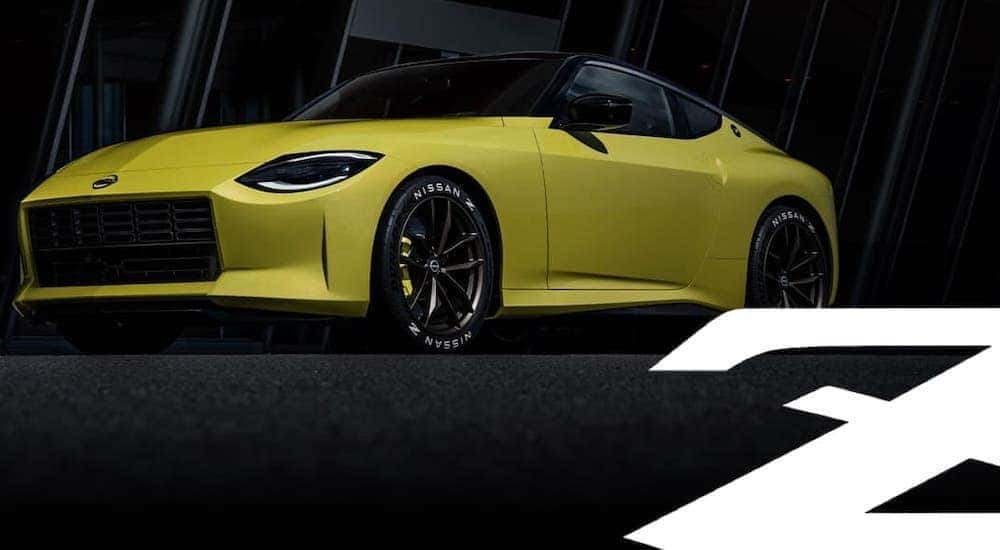
The first in what would become a long line of vehicles that offered racecar-like thrills even when commuting to work, the original Z car quickly became an iconic sports car. To signal the first new Z car in over a decade, Nissan recently unveiled the Z Proto. This car is a high-performance modern interpretation of the original 240Z, both in terms of style and substance. The style of the vehicle is a fresh and athletic take on the 240Z, topped off with an impeccably well-integrated call back to the 300ZX of the 1990s. While capturing many of the best aspects of the 1969 240Z’s original design, the Z Proto nonetheless appears more planted than the original car, with a low stance and significantly wider tires.
Those wide performance treads hint at the ability to move even faster than the new Z looks when sitting still. The Z Proto is powered by a twin-turbo V6, producing more than double the horsepower of the original 240Z while offering substantially better efficiency and dramatically lower emissions. The twin-turbo V6 engine layout has long been a staple of modern high-performance Nissans, including the 300ZX of the ’90s and the modern incarnation of the Nissan GT-R.
Overall, the incoming Nissan Z promises to be the perfect expression of six decades of Nissan innovation and racing history. Everything the company has learned over the years from both its roadgoing sports cars and its racetrack-only prototypes has led to a sleek and powerful demonstration of Nissan’s persistence and capability up to this point.
Future Ambitions
But just like on that fateful day in 1969, in the shadow of Mount Fuji, Nissan is not satisfied with the present. The automotive industry and landscape are changing faster now than ever before. The rapid rise of electric vehicles is pushing the industry forward with violent force. New technology and new mindsets have taken what was a novelty just two decades ago and made it a generally accepted future for virtually all personal transportation, with several areas of the world rolling out bans on internal combustion engine vehicles by mid-century.
The big push toward electric vehicles was not started at a government level, however. EVs offer vastly more efficient transport that is quieter, quicker, smoother, and cheaper to fuel. Not to mention the reliability gains and maintenance savings from having orders of magnitude fewer moving parts in an electric vehicle’s powertrain when compared to a standard car. The Nissan LEAF was one of the first commercially successful electric vehicles, and Nissan is building on that foundation with a new generation of more capable and universal designs.
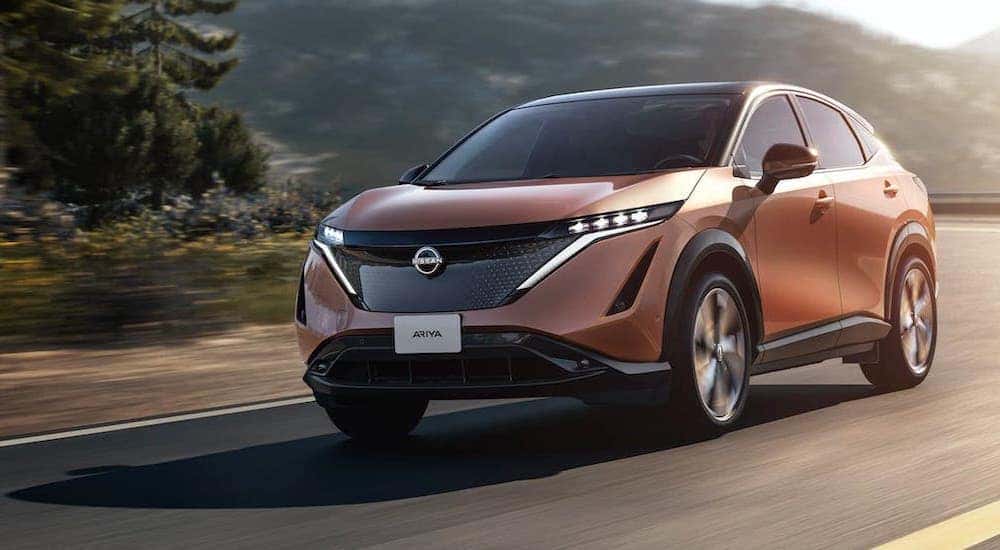
The recently-announced Nissan Ariya is among the first of the new wave of mainstream electric vehicles. The Ariya features multiple variants, all of which are completely electric. As such, they offer instantaneous torque delivery and the ability to be fueled completely by renewable energy sources. A major advancement over the first generations of electric vehicles will be the Ariya’s price tag, which is reported to start at around 40,000 dollars. This is roughly half what many earlier electric cars were sold for, and is possible partly due to Nissan leveraging new technologies, and partly because Nissan is a large enough mainstream automaker to allow for economies of scale.
This price and scale allow Nissan to bring the future to the world at large, with an EV that provides incredibly advanced driver-assist and safety technologies, as well as optional four-wheel drive and semi-autonomous highway driving. The Ariya promises to continue Nissan’s persistent and innovative path forward through automotive technology.
Join Nissan’s Future
All of this is the future of Nissan, coming soon to your local Nashville Nissan dealer. Nissan has been through much in the past 80 years and has accomplished the seemingly impossible both on and off the racetrack time and time again. Whether competing with the best in the world for a place on the podium or working to earn a spot in your driveway, Nissan has put its best foot forward both in the past and in the present. The result of all this is a very near future where an enthusiast sports car with a twin-turbo V6 engine and a six-speed manual transmission proudly shares the same badge with a hyper-efficient, nearly self-driving electric powerhouse.
0 comment(s) so far on The Future Of Nissan