

The Real Deal on Brake Line Service – From Your Service Team
Understanding the Vital Role of Your Brake Lines
Think of your braking system as a high-pressure conversation between your foot and your tires. When you press the pedal, you aren’t just pushing a lever; you are activating a hydraulic system that relies on brake lines to carry pressurized fluid from the master cylinder to the calipers. If those lines are compromised, that conversation gets interrupted, and your stopping power vanishes. In my years in the service department, I have seen how quickly a small leak can turn into a total loss of braking force, which is why we take every inspection so seriously.
Most modern vehicles, including the 2026 Nissan Rogue, utilize a mix of rigid metal tubes and flexible rubber hoses to navigate the chassis. These components are built to withstand incredible pressure, often meeting FMVSS 106 federal safety standards for hydraulic brake hoses. However, the environment under your car is harsh. Road debris, heat cycles, and moisture all work against the integrity of your brake tubing. If you ever feel the pedal start to sink or notice a puddle, it is time to reach out to us at (615) 442-3090 for a professional evaluation.
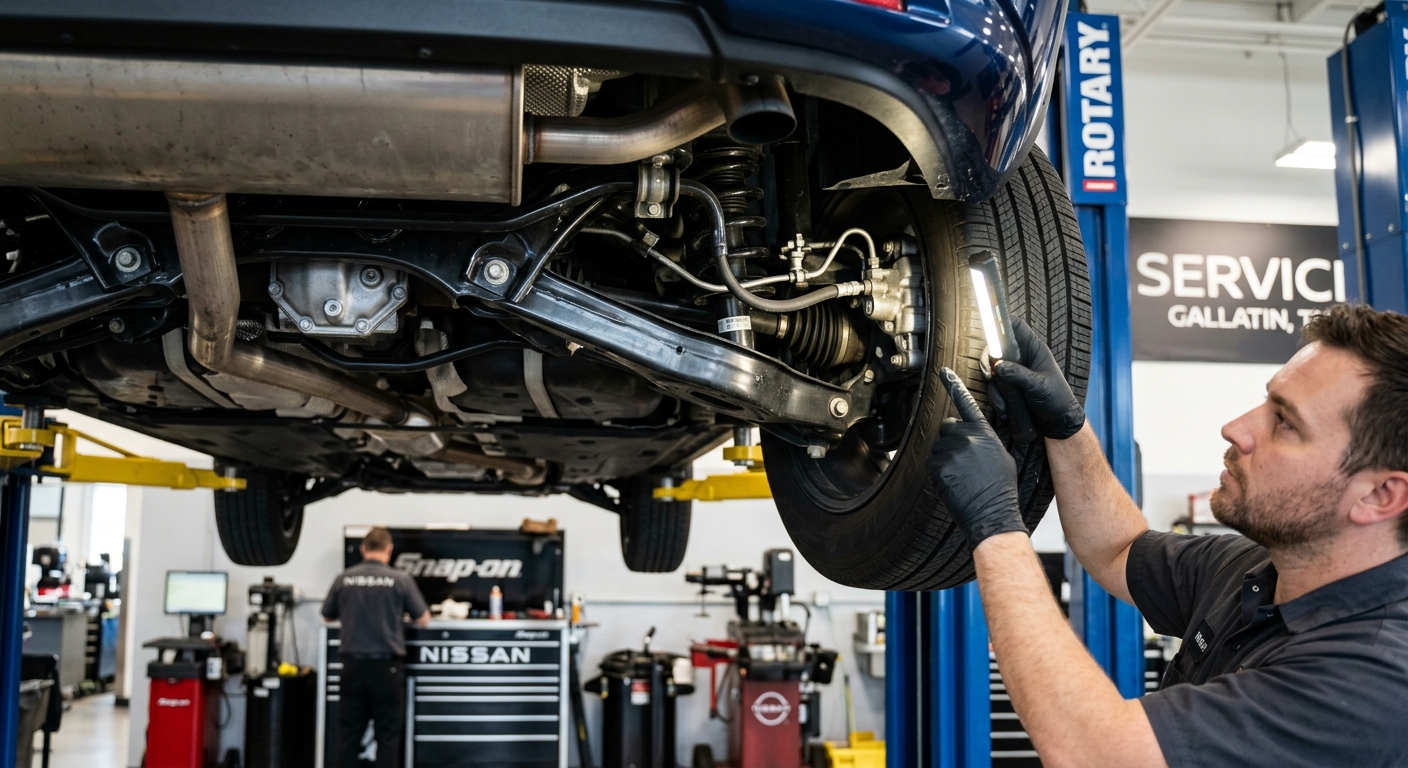
We often tell drivers that preventative maintenance is the best way to avoid a mid-drive emergency. Our team recommends a full brake system inspection every 12,000 miles or once a year. During this check, we look for rust spots, wet areas along the routing, and signs of corrosion that could lead to a rupture. If you suspect something is off, you can always drop by our Gallatin location for a quick look.
Table of Contents
- The Core Technical Difference: Double Flare vs. Bubble Flare
- Why Correct Flaring and Sealing Standards Matter for Your Safety
- Signs of Wear and How We Diagnose Compromised Brake Lines
- Professional Brake Service and Genuine Parts at Our Dealership
- Protecting Your Braking Performance in Middle Tennessee
The Core Technical Difference: Double Flare vs. Bubble Flare
One of the most common technical questions I get from car enthusiasts involves the specific way brake lines are sealed at their connection points. The “flare” is the spread end of the metal tube that sits against a fitting to create a leak-proof seal. While there are several types, the two you will hear about most often are the double flare and the bubble flare. Using the wrong one is a recipe for a hydraulic failure because the mating surfaces simply won’t align correctly.
A double flare (also known as an SAE or 45-degree flare) is the standard for most domestic and many Asian vehicles. To create this, the end of the brake tubing is actually folded back on itself before being flared outward. This creates a reinforced seal with two layers of metal, making it incredibly durable under the high pressures required to stop a vehicle like the 2026 Nissan Altima. If you are browsing our current Altima inventory, you are looking at a system designed for precision and longevity using these proven standards.
On the other hand, a bubble flare (or DIN/ISO flare) looks exactly like it sounds—a small “bubble” at the end of the tube. This is a single expansion of the metal that seats into a specific type of concave fitting. While common on European vehicles, we see them on various modern platforms as well. The 2026 Nissan Leaf and the 2026 Nissan Rogue PHEV utilize advanced regenerative braking systems, but they still rely on these physical hydraulic connections. Whether you are looking at new Leaf models or interested in Rogue PHEV options, the integrity of these flares is what keeps your brake fluid where it belongs.
Why Correct Flaring and Sealing Standards Matter for Your Safety
Safety isn’t just about having the latest driver-assist features; it starts with the mechanical foundation of the car. If a brake line is flared incorrectly—perhaps a double flare was forced into a bubble flare fitting—it might hold pressure for a few stops, but it will eventually fail. Because braking systems are hydraulic, they rely on constant, unyielding pressure. A microscopic gap in a seal allows air to enter the system, leading to a spongy brake pedal and significantly increased stopping distances.
Safety & Driver Assistance
Safety ratings and driver assistance systems
| Feature | S | SV | Rock Creek | Dark Armor | Platinum | SL |
|---|---|---|---|---|---|---|
| IIHS Rating | TOP SAFETY PICK | TOP SAFETY PICK | TOP SAFETY PICK | TOP SAFETY PICK | TOP SAFETY PICK | TOP SAFETY PICK |
Standard across all trims:
| Feature | Included |
|---|---|
| Forward Collision Warning | ✓ |
| Automatic Emergency Braking | ✓ |
| Lane Departure Warning | ✓ |
| Lane Keeping Assist | ✓ |
| Blind Spot Monitor | ✓ |
| Rear Cross-Traffic Alert | ✓ |
| Blind Spot Intervention | ✓ |
In my experience, the risk of DIY brake repair often comes down to these flares. Achieving a perfect SAE double flare requires specialized tools and a steady hand to ensure the metal doesn’t crack or sit off-center. We see many affordable cars come into our shop after a home repair attempt where the seal wasn’t quite right. If you are looking to browse budget-friendly vehicles, you want to be sure the previous brake service was done to industry standards.
We take pride in our work because we know what is at stake for our neighbors. When you browse our new car selection, you are getting a vehicle that has been factory-assembled to the highest safety specifications. Part of the reason many locals choose our dealership is our commitment to maintaining those factory standards throughout the life of the vehicle. We don’t take shortcuts with hydraulic lines because there is no room for error when it comes to your family’s safety.
Signs of Wear and How We Diagnose Compromised Brake Lines
How do you know if your brake lines are reaching the end of their lifespan? The most obvious sign is a brake warning light on your dashboard, but your senses can often tell you more. If you notice a soft pedal that feels like you’re stepping on a marshmallow, or if the pedal sinks all the way to the floor at a stoplight, you likely have air or a leak in the hydraulic system. On heavier vehicles like the 2026 Nissan Frontier, which is built for towing and payload, maintaining brake pressure is even more critical.
When we bring a vehicle in for diagnostic service, we perform a multi-point inspection. We look for:
- Visible corrosion or “flaking” on metal lines.
- Wet spots or oily residue near the wheel wells.
- Cracking or swelling in the flexible rubber brake hoses.
- Dark brown or black brake fluid, which indicates moisture contamination.
If you are currently looking to shop for a new Frontier, you’ll appreciate the Nissan Safety Shield® 360, but remember that even the best tech needs solid brake hardware. We often see older trucks that have spent years on the road start to show rust spots on the lines. If you are scanning our new vehicle inventory or looking to find a new Nissan vehicle, you can rest easy knowing those systems are pristine. For those driving older models, a quick visual inspection by our techs can prevent a brake failure before it happens.
Professional Brake Service and Genuine Parts at Our Dealership
When it comes to brake repair, using genuine Nissan parts is non-negotiable for us. Aftermarket brake hoses might fit, but they may not have the same expansion resistance or heat shielding as OEM components. For instance, some high-performance setups use stainless-steel braided hoses with a PTFE inner tube to ensure the lines don’t expand under pressure, providing a much firmer pedal feel. Whether you need to order specific parts online or want to visit our parts department to see what we have in stock, we ensure everything meets Nissan’s engineering specs.
Pricing
MSRP and destination charges (source: MarketCheck VIN Decode (consensus))
| Feature | S | SV | Rock Creek | Dark Armor | Platinum | SL |
|---|---|---|---|---|---|---|
| Starting MSRP | $31,610 | $33,806 | $37,113 | $37,171 | $42,894 | $48,485 |
Lowest starting MSRP: S at $31,610
The 2026 Nissan Rogue is a great example of where precision matters. With an MSRP starting at $31,610 for the S trim and going up to $48,485 for the SL, these vehicles are high-tech machines. The braking system is integrated with Automatic Emergency Braking and Lane Keeping Assist, meaning the hydraulic response must be instantaneous. We serve a wide area, and whether you are a driver in Portland or looking for a dealership near Westmoreland, our technicians are trained to handle these complex systems.
We want to make sure every driver in our community has access to expert service. We are proud to be a Nissan dealer near Nashville, and we regularly see customers who travel from all over the region.
- Nissan Dealer Near Portland
- Nissan Dealer Near Westmoreland
- Hendersonville Nissan Dealer
- Lebanon Nissan Dealer
- Nissan Dealer Near Goodlettsville
If you are searching to find a car dealer near you, our team is ready to help with everything from fluid flushes to full brake line replacement.
Protecting Your Braking Performance in Middle Tennessee
Living in Middle Tennessee means our vehicles deal with a variety of conditions. While we have mild seasonal swings, we still see enough humidity and occasional road salt to cause metal oxidation over time. This is especially true for those who live in the more rural areas of Cross Plains, where gravel roads and farm dust can trap moisture against your undercarriage. I always suggest that my customers in Cross Plains spray out their wheel wells regularly to keep debris from sitting on the brake fittings.
Engine & Performance
Powertrain specifications across trim levels
| Feature | S | SV | Rock Creek | Dark Armor | Platinum | SL |
|---|---|---|---|---|---|---|
| Engine | 1.5L I3 | 1.5L I3 | 1.5L I3 | 1.5L I3 | — | — |
| Transmission | CVT | CVT | CVT | CVT | — | — |
| Drivetrain | FWD | FWD | 4WD | FWD | — | — |
For those who have made the switch to electric driving, the braking conversation changes slightly but remains just as important. If you shop our new electric vehicles, you’ll find that regenerative braking handles much of the work, but the friction brakes and hydraulic lines are still there as your primary safety net. Even if you aren’t using your brake pads as often, the brake fluid still needs to be replaced every 20,000 miles or 2 years to prevent internal corrosion from moisture absorption.
Whether you are commuting in a 1.5L I3 Rogue with its efficient CVT or hauling a trailer, your brake lines are the unsung heroes of your daily drive. If you have any questions about pedal feel or want us to check your fluid levels, give us a quick call today. You can also get directions to our showroom to speak with a service advisor in person. We are here to ensure that every time you hit the brakes, your car responds exactly the way it should.
0 comment(s) so far on The Real Deal on Brake Line Service – From Your Service Team