

Understanding the Vital Roles of Wheel Alignment and Tire Balancing
Understanding the Vital Roles of Wheel Alignment and Tire Balancing
Maintaining the connection between your vehicle and the road involves two distinct mechanical procedures that are often confused: wheel alignment and tire balancing. While both are essential for a smooth ride and long-lasting tires, they address completely different issues. Alignment refers to the adjustment of your vehicle’s suspension system—the complex network of components that connects a vehicle to its wheels—rather than the wheels or tires themselves. Balancing, conversely, compensates for weight disparities in the tire and wheel assembly.
A primary distinction is that alignment focuses on the angles at which the tires contact the pavement. Proper alignment ensures that your tires are parallel to each other and perpendicular to the ground. When these angles are off, even by a fraction of a degree, your vehicle may pull to one side or cause the steering wheel to sit at an awkward angle while you are driving straight. In contrast, tire balancing is about the distribution of mass. Because no tire or wheel is perfectly symmetrical in weight, small lead or zinc weights are attached to the rim to ensure the assembly spins without wobbling.
Ignoring these services can lead to a significant increase in ownership costs. Misaligned wheels create excessive rolling resistance, forcing your engine to work harder and consuming more fuel. Meanwhile, unbalanced tires create centrifugal force issues that lead to vibrations, which can prematurely wear out suspension bushings and shocks. For drivers navigating the varied terrain around Cross Plains, keeping these systems in check is the difference between a relaxing drive and a fatiguing struggle with the steering wheel.
If you suspect your vehicle is drifting or vibrating, our service team is ready to help. You can find our Gallatin showroom and service center easily to have a technician perform a diagnostic check. For immediate questions about scheduling or symptoms, feel free to give us a quick call to speak with a service advisor.
Table of Contents
- How Wheel Alignment Keeps Your Vehicle Tracking Straight
- How Tire Balancing Eliminates High-Speed Vibrations
- Signs Your Nissan Needs Immediate Service on Middle Tennessee Roads
- Common Questions About Tire Maintenance and Steering Calibration
- Quick Answers Before You Visit
- Protecting Your Investment with Comprehensive Vehicle Care
How Wheel Alignment Keeps Your Vehicle Tracking Straight
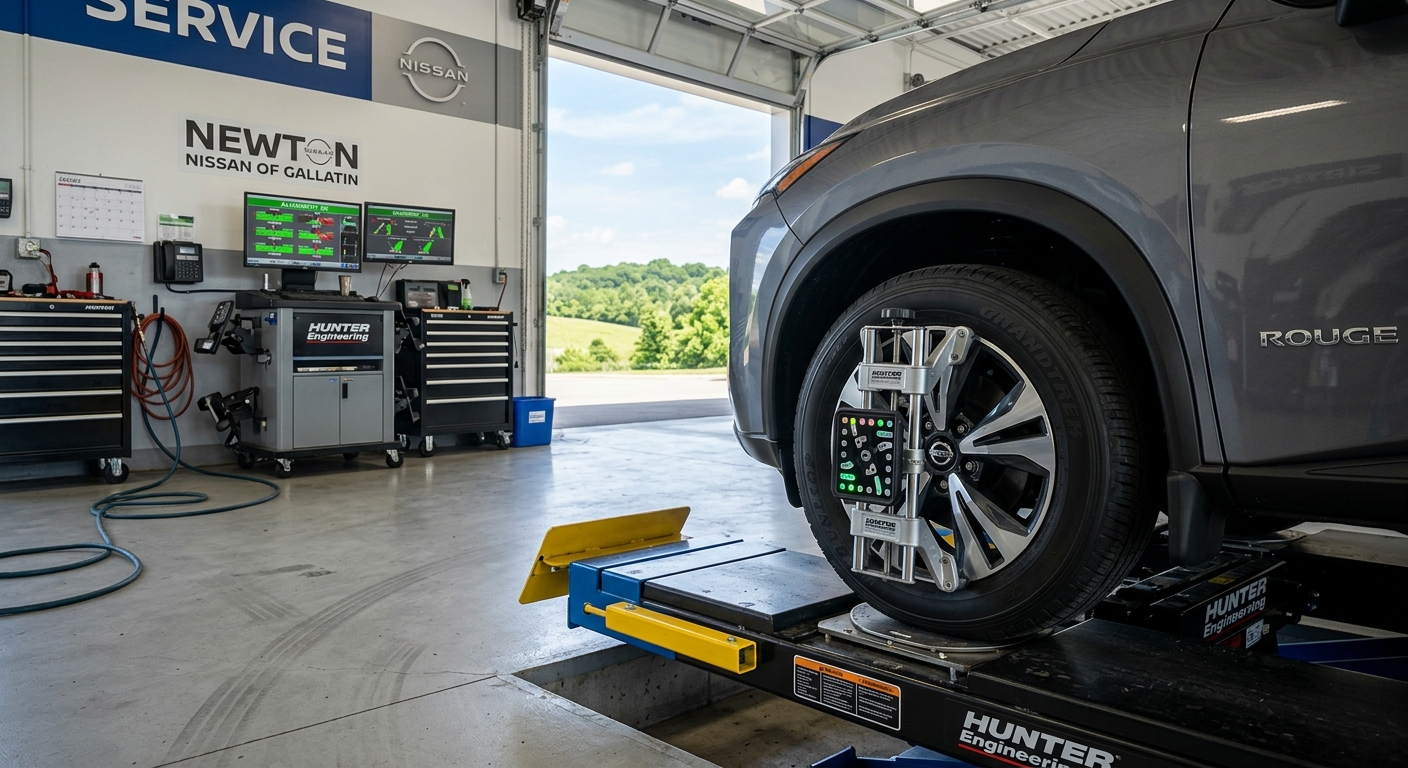
Wheel alignment, sometimes referred to as a front-end or four-wheel alignment, involves the precise calibration of three primary angles: camber, caster, and toe. Camber is the inward or outward tilt of the tire when viewed from the front; caster identifies the angle of the steering axis; and toe represents the direction the tires are pointing relative to the vehicle’s centerline. When these angles are set to factory specifications, your tires wear evenly and your vehicle tracks straight without constant correction from the driver.
Wheels & Ground Handling
Wheels & Ground Handling — available options with MSRP pricing
| Package | S | SV | Rock Creek | Dark Armor | Platinum | SL |
|---|---|---|---|---|---|---|
| 17″ Alloy Wheel Package | — | $250 | — | — | — | — |
| Splash Guards (PIO) | $260 | $260 | $260 | $260 | — | — |
| Chrome Rear Bumper Protector (PIO) | — | $190 | — | $190 | — | — |
Modern vehicles equipped with Advanced Driver Assistance Systems (ADAS) are particularly sensitive to alignment. For instance, the 2026 Nissan Rogue features Lane Departure Warning and Lane Keeping Assist, technologies that rely on the vehicle’s physical steering geometry being perfectly synced with its electronic sensors. If the mechanical alignment is skewed, these safety systems may not intervene correctly or could provide false alerts. This is why we recommend an alignment check whenever you browse new Nissan inventory and take delivery of a vehicle, or after hitting a significant road hazard.
The impact on your budget is just as important as the impact on safety. A vehicle with poor alignment essentially “drags” its tires sideways as it moves forward, a phenomenon known as scrubbing. This can strip away thousands of miles of tread life in a matter of months. Whether you are looking to shop new Nissan vehicles like the 2026 Nissan Altima or the rugged 2026 Nissan Frontier, maintaining alignment protects your investment. Even the efficient 2026 Nissan Rogue PHEV requires precise alignment to maintain its fuel economy advantages and reduce rolling resistance.
If you are considering a vehicle for family duties or heavy commutes, such as the 2026 Nissan Pathfinder or the 2026 Nissan Murano, remember that larger SUVs place more stress on suspension components. We offer various accessories to help protect these vehicles, including Splash Guards (PIO) for $260 on the Rogue. For those looking to customize their ride, our team can help you shop new Nissan Murano inventory and explain how the 17″ Alloy Wheel Package available on the SV trim for $250 might affect your long-term maintenance needs.
How Tire Balancing Eliminates High-Speed Vibrations
While alignment deals with angles, tire balancing is a matter of physics and weight distribution. Every tire and wheel has a “heavy spot,” a tiny variation in the density of the rubber or the casting of the metal. At low speeds, this imbalance is negligible. However, once you reach highway speeds, that heavy spot creates a vertical or lateral vibration. If you feel a shaking in the steering wheel, it typically indicates that the front tires are out of balance; if the vibration is felt through the seat or floorboard, the issue is likely with the rear tires.
Engine & Performance
Powertrain specifications across trim levels
| Feature | S | SV | Rock Creek | Dark Armor | Platinum | SL |
|---|---|---|---|---|---|---|
| Engine | 1.5L I3 | 1.5L I3 | 1.5L I3 | 1.5L I3 | — | — |
| Transmission | CVT | CVT | CVT | CVT | — | — |
| Drivetrain | FWD | FWD | 4WD | FWD | — | — |
The process of balancing involves placing the wheel and tire assembly on a specialized machine that spins it at high speeds to identify exactly where the weight is uneven. A technician then applies small, calibrated weights to the rim to counteract those heavy spots. This is a standard part of the tire installation process, but weights can occasionally fall off or tires can develop flat spots over time. Keeping your tires balanced is vital for vehicles across all price points, whether you browse used cars or participate in our high school car giveaway.
Unbalanced tires lead to a specific type of wear known as cupping or scalloping. This appears as dipped, wavy patterns across the tread surface. Not only does this make the tires extremely noisy, but it also reduces the amount of rubber in contact with the road, compromising your braking distance and wet-weather traction. For those who browse affordable cars in our pre-owned inventory, ensuring a fresh balance is one of the most cost-effective ways to extend the life of a set of tires.
Precision is key, especially with high-performance models or vehicles with larger wheel diameters. A slight imbalance on a large wheel generates more force than on a smaller one, making the vibration much more noticeable to the driver. Regular balancing every 5,000 to 7,500 miles—usually performed during a tire rotation—ensures that your ride remains smooth and that your suspension components aren’t subjected to unnecessary stress.
Signs Your Nissan Needs Immediate Service on Middle Tennessee Roads
The road conditions in Middle Tennessee, from the busy corridors near Nashville to the rural routes in Westmoreland, can take a toll on your vehicle’s steering and suspension. Potholes, uneven pavement, and debris are common culprits that can knock a vehicle out of alignment or cause a wheel weight to dislodge. One of the most obvious signs that you need a check-up is a “crooked” steering wheel; if the Nissan logo in the center of your wheel isn’t level while you are driving straight, your alignment is definitely out of spec.
Warranty
Factory warranty coverage
| Coverage | Duration |
|---|---|
| Basic | 3 years / 36,000 miles |
| Powertrain | 5 years / 60,000 miles |
| Corrosion | 5 years / unlimited miles |
| Roadside Assistance | 3 years / 36,000 miles |
Another red flag is active pulling. If you momentarily relax your grip on the steering wheel on a flat, straight road and the vehicle immediately drifts toward the shoulder or the centerline, the suspension geometry is likely compromised. This is especially critical for residents in Portland who frequently commute on high-speed routes, as pulling can become more pronounced and dangerous at higher velocities. We often see drivers who have become so used to “fighting” their steering wheel that they don’t realize how much effort they are exerting until the alignment is corrected.
Specific wear patterns on your tire tread act as a diagnostic map for our technicians:
- Feathering: Tread blocks are smooth on one side and sharp on the other, usually indicating improper toe settings.
- Camber Wear: The inside or outside edge of the tire is significantly more worn than the rest, suggesting the tire is tilting too far.
- Vibration at 55+ MPH: This is the classic signature of an unbalanced tire assembly.
Every new Nissan comes with a solid foundation of protection, including a Basic warranty of 3 years / 36,000 miles and a Powertrain warranty of 5 years / 60,000 miles. Additionally, the Roadside Assistance coverage for 3 years / 36,000 miles provides peace of mind if a tire issue leaves you stranded. Whether you are looking for a Nissan dealer near Westmoreland or a used Nissan inventory near Portland, our service department can ensure your vehicle remains within these warranty guidelines by performing required maintenance.
Common Questions About Tire Maintenance and Steering Calibration
When I’m helping a customer understand their service bill, the question I get most often is whether they truly need both an alignment and a balance at the same time. The answer depends on the symptoms. If the car is vibrating, we start with a balance. If the car is pulling, we look at the alignment. However, because the labor overlaps and both are essential for tire longevity, performing them together is often the most efficient way to maintain your vehicle. This is a common topic during our service happy hour, where we aim to make maintenance more accessible for everyone.
Many drivers also ask if they need an alignment every time they buy new tires. We strongly recommend it. Installing brand-new tires on a vehicle with skewed alignment is like putting on a new pair of expensive running shoes and then walking on the sides of your feet; you will ruin the shoes much faster than necessary. Aligning the vehicle ensures those new tires start their life with the best possible contact patch. To make this process easier, you can learn about Newton Fastpass to see how we streamline both the buying and servicing experience.
We also receive questions regarding how often these checks should occur. For most Nissan models, an annual alignment check is a good rule of thumb, or every 12,000 miles. However, if you’ve recently hit a deep pothole or a curb, you shouldn’t wait for the next interval. Our commitment to the community goes beyond the service bay; you can learn about our community involvement and see how we support local drivers in staying safe on the road.
If you are considering a pre-owned vehicle, you can learn about our CPO program, which includes a rigorous inspection of the steering and suspension systems. This ensures that every Certified Pre-Owned Nissan we sell meets strict standards for alignment and balance before it ever reaches your driveway. You can learn about us and our dedication to transparent service to understand why so many local drivers trust us with their tire maintenance.
Quick Answers Before You Visit
Q: Will an alignment fix a vibrating steering wheel at highway speeds?
Usually, no. A vibration felt in the steering wheel is almost always caused by an unbalanced tire rather than an alignment issue. Alignment problems typically cause pulling or uneven tire wear, but rarely cause a high-speed shake.
Pricing
MSRP and destination charges (source: MarketCheck VIN Decode (consensus))
| Feature | S | SV | Rock Creek | Dark Armor | Platinum | SL |
|---|---|---|---|---|---|---|
| Starting MSRP | $31,610 | $33,806 | $37,113 | $37,171 | $42,894 | $48,485 |
Lowest starting MSRP: S at $31,610
Safety & Driver Assistance
Safety ratings and driver assistance systems
| Feature | S | SV | Rock Creek | Dark Armor | Platinum | SL |
|---|---|---|---|---|---|---|
| IIHS Rating | TOP SAFETY PICK | TOP SAFETY PICK | TOP SAFETY PICK | TOP SAFETY PICK | TOP SAFETY PICK | TOP SAFETY PICK |
Standard across all trims:
| Feature | Included |
|---|---|
| Forward Collision Warning | ✓ |
| Automatic Emergency Braking | ✓ |
| Lane Departure Warning | ✓ |
| Lane Keeping Assist | ✓ |
| Blind Spot Monitor | ✓ |
| Rear Cross-Traffic Alert | ✓ |
| Blind Spot Intervention | ✓ |
Q: Can I just get the front two wheels aligned?
While some older vehicles only allowed for front-end adjustments, most modern Nissans require a four-wheel alignment. This ensures that the rear wheels are tracking directly behind the front wheels, which is essential for the handling and safety of the vehicle.
Q: Does my tire pressure affect my alignment?
Tire pressure does not change the physical angles of your suspension, but incorrect pressure can mimic alignment symptoms. Under-inflated tires can cause the vehicle to pull or track poorly, so we always check and adjust tire pressure before performing an alignment.
Q: How long does a standard alignment and balancing service take?
A professional alignment typically takes about an hour, and balancing all four tires takes roughly 30 to 45 minutes. When performed together as part of a routine maintenance visit, you can expect to be back on the road in under two hours.
Q: Can worn suspension parts prevent a proper alignment?
Yes. If components like tie rods, ball joints, or control arm bushings are excessively worn or damaged, the vehicle cannot hold an alignment. Our technicians perform a thorough suspension inspection before every alignment to ensure the adjustments will actually last.
Protecting Your Investment with Comprehensive Vehicle Care
Maintaining the alignment and balance of your vehicle is one of the simplest ways to ensure a safe, comfortable, and cost-effective driving experience. By addressing these needs early, you prevent the “domino effect” of mechanical wear where a simple tire issue leads to expensive suspension repairs. Our team is dedicated to providing high-quality care for every vehicle that enters our service bay, ensuring that your Nissan performs exactly as the engineers intended.
Beyond the mechanical adjustments, we offer a variety of protection accessories to keep your vehicle in top shape. For the 2026 Nissan Rogue, you can opt for the Floor Mats, 1-Piece Cargo Area Protector, Seatback Protector and First Aid Kit (PIO) for $465, which helps maintain the interior while you focus on the exterior mechanics. We also offer the Retractable Cargo Cover (PIO) for $205 across most trims, including the S, SV, and Rock Creek, to keep your belongings secure while you enjoy a smooth, vibration-free ride.
Whether you are looking for a Nashville car dealership with a robust service department or you want to find a car dealer near me that understands the specific needs of Middle Tennessee drivers, we are here to help. Proper tire care is a cornerstone of vehicle safety, and we take that responsibility seriously.
To experience the difference that professional alignment and balancing can make, we invite you to visit us. You can easily get directions to our Gallatin location or reach out to our service advisors by giving us a quick call to schedule your next appointment. Let us help you keep your vehicle running straight and smooth for miles to come.
0 comment(s) so far on Understanding the Vital Roles of Wheel Alignment and Tire Balancing