

What Fuel Economy Standards Contributed to the Cancellation of the Nissan Xterra?
What Fuel Economy Standards Contributed to the Cancellation of the Nissan Xterra?
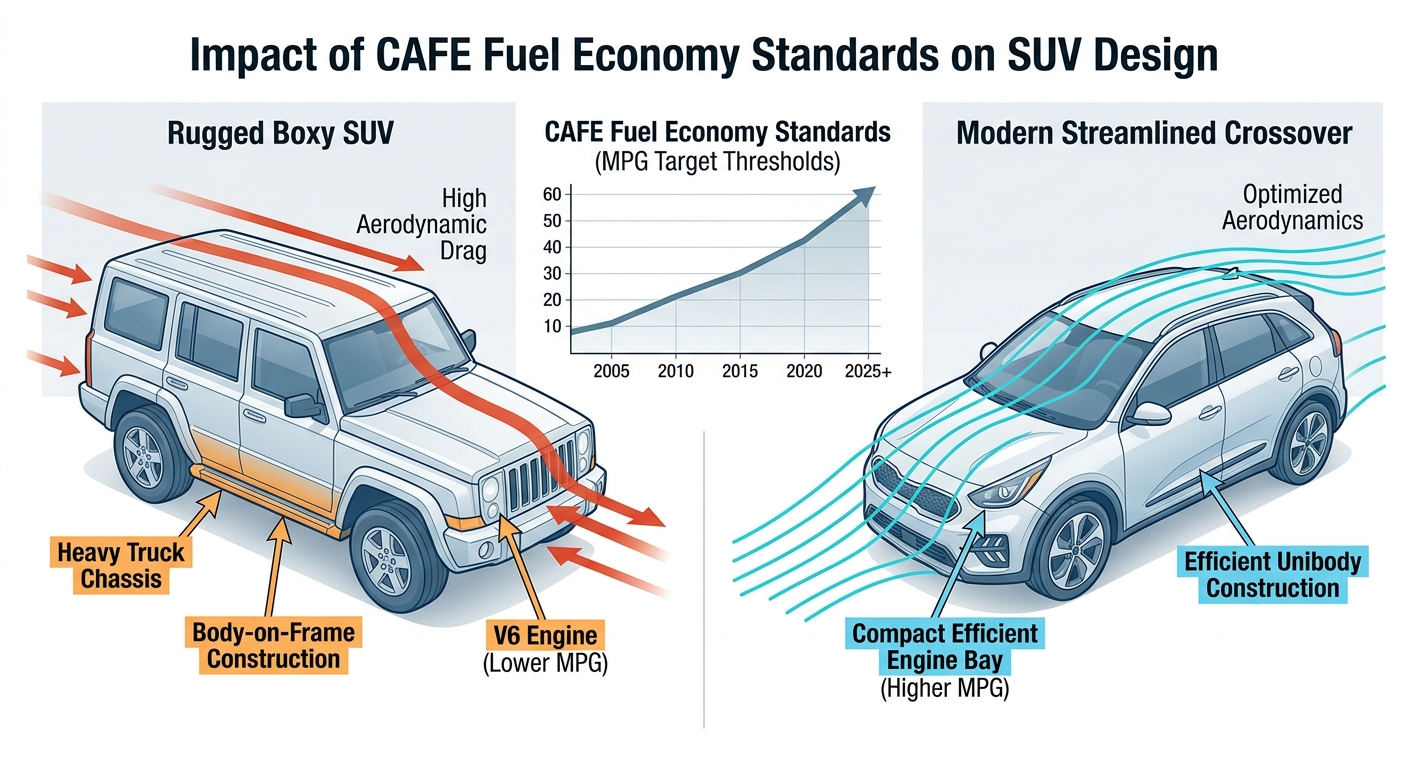
Corporate Average Fuel Economy (CAFE) standards mandated steady increases in overall fleet fuel efficiency, forcing auto manufacturers to phase out naturally aspirated V6 engines paired with heavy body-on-frame truck platforms. Because the Nissan Xterra utilized a non-aerodynamic, traditional truck architecture, updating it to meet rising Federal MPG thresholds required expensive powertrain redesigns that were difficult to justify against lighter, more fuel-efficient unibody crossovers.
During the final production run of the second-generation model, federal fuel economy benchmarks escalated rapidly. The Xterra relied on a high-displacement 4.0-liter V6 engine paired with a five-speed automatic or six-speed manual transmission. While this powertrain offered excellent low-end grunt for off-roading, its EPA-estimated fuel economy struggled to compete with the strict fleet-wide averages required by regulators. Auto manufacturers faced heavy financial penalties if their combined lineup did not meet annual miles-per-gallon targets.
To comply with federal regulations, carmakers shifted development budgets toward aerodynamic crossover platforms built on unibody frames. These modern utility vehicles offered turbocharged four-cylinder engines and continuously variable or multi-speed transmissions that easily achieved significantly higher fuel efficiency. Modifying the heavy frame, square front profile, and upright stance of the Xterra to achieve similar efficiency would have compromised the vehicle’s legendary off-road utility.
Engineers also faced safety compliance updates requiring side-curtain airbags and rollover protections that would have necessitated a complete structural overhaul. Combined with declining demand for body-on-frame midsize SUVs in the mid-2010s, the investment required to re-engineer the powertrain and chassis outweighed the projected return. If you are interested in exploring how modern Nissan SUVs have evolved to balance efficiency and power, please stop by our Gallatin showroom or give our team a call at (615) 442-3090 to test drive our current inventory.
Table of Contents
- Is Nissan Bringing Back the Xterra for 2027 on a Body-on-Frame Platform?
- What Engine and Transmission Specs Are Expected in the Revived Xterra?
- How Did the Original Nissan Xterra Perform Off-Road, Tow, and Clear Obstacles?
- How Does Legacy Xterra Capability Match Middle Tennessee Driving Demands?
- Common Questions About the Nissan Xterra Return and Legacy Specs
- Explore Nissan SUV and Truck Options at Newton Nissan
Is Nissan Bringing Back the Xterra for 2027 on a Body-on-Frame Platform?
Nissan executive leadership has publicly confirmed active development evaluations for bringing back the Xterra, with expectations pointing toward a 2027 or 2028 model year launch. To preserve its off-road legacy, any revived model will feature a true body-on-frame architecture rather than a unibody crossover design, utilizing the proven midsize Nissan Frontier pickup truck platform.
Enthusiasts and truck buyers have called for the return of a rugged, non-nonsense off-roader to compete directly with vehicles like the Ford Bronco and Jeep Wrangler. Nissan executives recognize that transforming the nameplate into a soft-road crossover would alienate its dedicated fanbase. Building a new utility vehicle on the Frontier chassis allows the brand to deliver real four-wheel-drive capability, high ground clearance, and durable box-frame construction without engineering an expensive custom platform from scratch.
First-time SUV shoppers walking our lot often ask whether a revived model would stick to its truck roots or switch to a car chassis. The commitment to a body-on-frame setup ensures that a next-generation model can handle severe trail work, heavy utility equipment, and off-grid camping gear. This design language maintains a short front overhang, aggressive approach angles, and an upright tailgate design reminiscent of the original model.
While official launch dates remain unannounced, industry projections suggest an unveiling could occur in late 2026 or early 2027. Until an official production vehicle reaches dealership floors, drivers seeking rugged utility can explore our pre-owned vehicle selection to find robust four-wheel-drive trucks and SUVs engineered for severe conditions.
What Engine and Transmission Specs Are Expected in the Revived Xterra?
A revived Nissan Xterra is expected to share the Frontier powertrain lineup, featuring a 3.8-liter V6 engine generating 310 hp and 281 lb-ft of torque paired with a 9-speed automatic transmission. While off-road enthusiasts frequently request a manual option, modern fuel-efficiency calibration and towing optimization favor the multi-speed automatic gearbox.
The direct-injected 3.8-liter V6 engine represents a major engineering leap over the older 4.0-liter mill used in the legacy model. Delivering 310 hp, it provides swift acceleration and consistent climbing power on steep trails. The 9-speed automatic transmission features closely stacked gear ratios that keep the engine in its optimal powerband while improving highway fuel economy through low-rpm overdrive gears.
Expected mechanical and powertrain highlights include:
- Direct-injection engine tuning designed to optimize throttle response across low-speed trails and high-speed highway cruising.
- Shift-on-the-fly four-wheel drive with selectable high and low dual-range transfer case ratios.
- Electronic hill descent control and hill start assist systems integrated directly into the traction management computer.
- Multi-terrain drive mode selectors that automatically recalibrate throttle sensitivity and transmission shift points for mud, sand, or gravel.
While a six-speed manual gearbox remains a popular wish-list item among traditionalists, electronic driver-assist software integrates far more smoothly with automatic gearboxes. Drivers planning to upgrade their current trail rig when new models launch can value your trade-in online to prepare their budget for a future purchase.
How Did the Original Nissan Xterra Perform Off-Road, Tow, and Clear Obstacles?
The second-generation Nissan Xterra delivered up to 9.5 inches of ground clearance on PRO-4X trims, featuring a standard 4.0-liter V6 engine, an available electronic locking rear differential, and a maximum towing capacity of 5,000 lb. Base trims started at 8.2 inches of ground clearance, providing generous approach and departure angles for trail obstacles.
Engineered specifically for outdoor enthusiasts, the legacy model utilized a rigid steel frame derived from Nissan’s full-size truck architecture. The off-road-focused PRO-4X trim featured heavy-duty Bilstein gas-pressurized shocks, steel skid plates protecting the oil pan, fuel tank, and transfer case, and aggressive all-terrain tires. The electronic locking rear differential ensured that both rear wheels rotated at identical speeds when traversing slick mud or uneven rock crawlings, delivering maximum traction.
The vehicle featured practical towing and utility capabilities designed for active lifestyles:
- Maximum towing capacity of 5,000 lb when properly equipped, allowing owners to haul small travel trailers, boat trailers, or utility rigs.
- Integrated roof rack system with a covered gear basket built to hold wet or dirty equipment outside the main cabin.
- Washable vinyl cargo floor and fold-flat rear seats that created an easily cleanable storage bay.
- High approach and departure angles that prevented front bumper scraping when dropping into steep ditches or scaling ledges.
These heavy-duty specifications earned the original SUV a dedicated following among outdoor adventurers. Customers looking to secure financing for an off-road-capable truck or SUV can start your application through our online finance center to review available loan options.
How Does Legacy Xterra Capability Match Middle Tennessee Driving Demands?
Traditional body-on-frame construction and selectable four-wheel drive handle steep rural grades, unpaved farm access paths, and slick boat ramps with reliable mechanical grip. That heavy-duty architecture gives local drivers the ground clearance and frame rigidity needed when moving heavy equipment or navigating unmaintained back roads.
The gently rolling farmland and wooded creek paths around Cross Plains demand solid underbody clearance and true low-range four-wheel drive during wet seasons. Navigating rutted field access lanes or hauling fencing supplies across soft soil requires an undercarriage built to resist impact. High ground clearance keeps vital components like the oil pan and exhaust clear of rocks and fallen branches, preventing expensive trail damage.
For drivers who routinely haul utility trailers, farm equipment, or small boats to local rivers, a boxed frame offers rigid stability that unibody crossovers cannot replicate. Proper frame articulation reduces body flex when driving across uneven pastures or climbing rutted hillsides. If you currently operate a legacy truck or utility vehicle and need maintenance components, you can order genuine Nissan parts online to keep your vehicle operating at peak performance.
Common Questions About the Nissan Xterra Return and Legacy Specs
Q: Will a new Nissan Xterra offer a manual transmission option?
While an available manual gearbox remains a top request from automotive enthusiasts, Nissan has not confirmed a manual transmission for a future production model. The current Frontier platform relies exclusively on a 9-speed automatic transmission, which offers better fuel efficiency, precise towing control, and seamless integration with modern safety electronics.
Q: What mechanical issue commonly affected second-generation Xterra models?
Earlier second-generation models equipped with automatic transmissions produced between 2005 and 2010 were susceptible to radiator cooler line failures. This condition allowed engine coolant to mix with automatic transmission fluid, often leading to internal transmission damage. Later models resolved this issue with updated radiator designs.
Q: How does a body-on-frame SUV differ from a unibody crossover?
A body-on-frame vehicle constructs the passenger cab separately from a heavy steel ladder frame. This setup delivers higher torsional rigidity, superior towing capacity, and durability over rough terrain. Unibody crossovers integrate the frame and body into a single structure, prioritizing lighter curb weight, car-like handling, and maximum fuel economy over extreme off-road durability.
Q: What was the maximum towing capability of the legacy Xterra?
When equipped with the factory tow package and a proper class III hitch, the second-generation model offered a maximum tow rating of 5,000 lb. This rating allowed owners to pull utility trailers, lightweight campers, or personal watercraft with confidence.
Q: How can local buyers prepare to purchase a pre-owned or new off-road SUV?
The agricultural lanes and gravel hill climbs around Westmoreland demand thorough vehicle inspections before purchase. Buyers should check underbody frame rails for corrosion, test low-range four-wheel-drive engagement, and evaluate suspension components. You can explore options through our certified pre-owned vehicle program or simplify your purchase steps using our online buying tools.
Explore Nissan SUV and Truck Options at Newton Nissan
Newton Nissan of Gallatin offers full access to Nissan’s latest lineup of truck-based capability and family SUVs, backed by transparent pricing and flexible purchasing options. Whether you are searching for a current Frontier pickup or exploring pre-owned rugged SUVs, our team is ready to walk you through every option on the lot.
Our sales team provides complete transparency on vehicle specifications, towing capacities, and off-road packages. We take pride in serving drivers with genuine expertise and personalized service tailored to your driving habits.
Take the next step in finding your ideal truck or utility vehicle today:
- Take a test drive by visiting our Newton Nissan location.
- Contact our specialists directly by giving us a call at (615) 442-3090.
- View real-time availability through our online new-vehicle inventory.
0 comment(s) so far on What Fuel Economy Standards Contributed to the Cancellation of the Nissan Xterra?