

What Makes Brake Line DIY Work Risky?
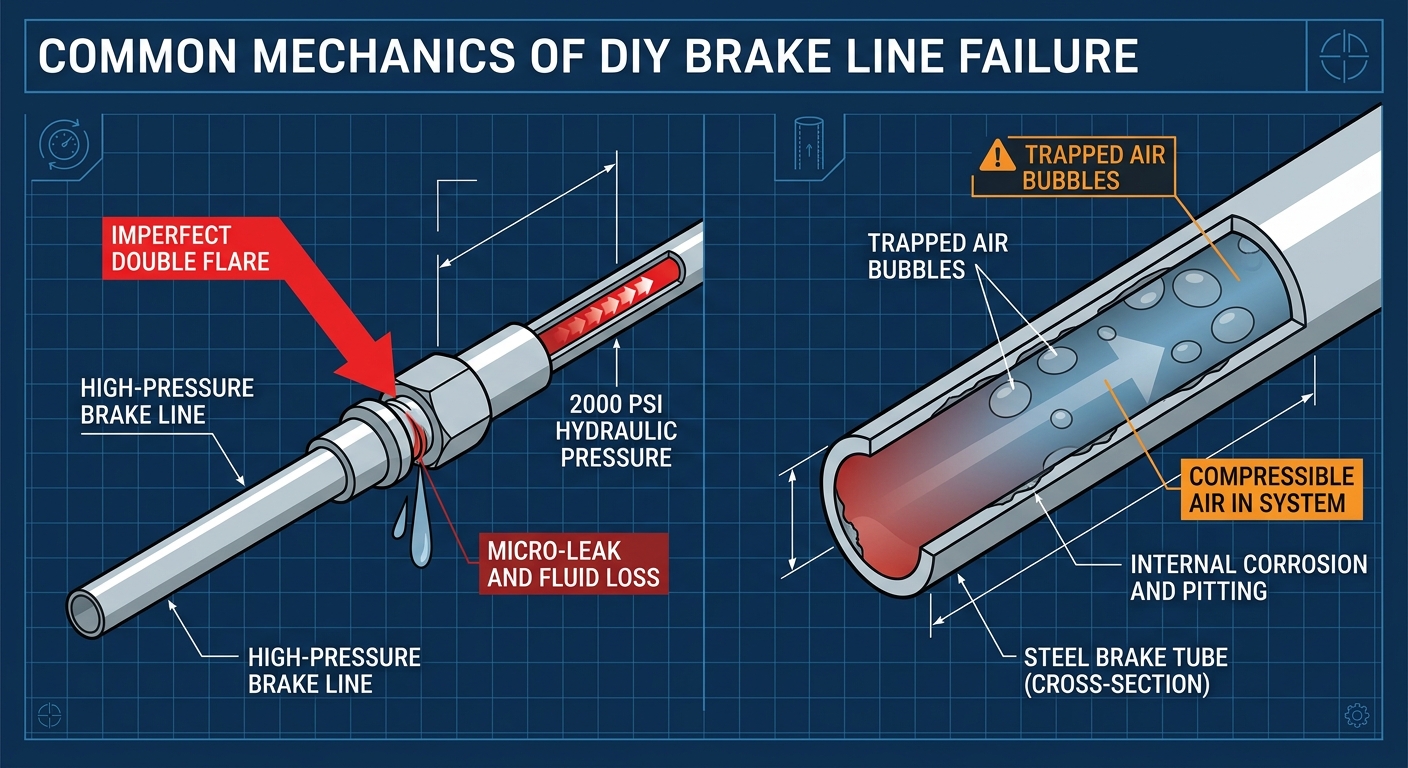
DIY brake line work is extremely risky because automotive brake systems operate under hydraulic pressure up to 2,000 PSI. Attempting at-home repairs without specialized flaring tools or precise torque calibrations often leads to incomplete fluid seals, micro-leaks, or trapped air pockets. These defects compromise hydraulic pressure, leading to sudden pedal loss and severe braking failure.
Automotive braking systems rely on rigid steel tubing and flexible high-pressure hoses to transfer mechanical force from your foot directly to the wheel calipers. Federal safety guidelines under FMVSS 571.106 dictate strict structural integrity and sealing performance standards for these hydraulic components. When replacing a damaged hard line at home, creating a leak-free double flare or ISO bubble flare requires specialized hydraulic flaring dies. Inexpensive hand tools frequently yield uneven flares or cracked tubing walls, allowing fluid to seep past the flare nut under load.
Bleeding air from a modern brake system presents another major hurdle for DIY mechanics. Air compresses easily, unlike hydraulic fluid. If air remains trapped inside the brake lines or the Anti-lock Braking System (ABS) hydraulic control unit, pressing the brake pedal compresses the air pocket instead of moving the caliper pistons. Purging air completely from modern valving often requires computerized diagnostic tools to cycle the ABS solenoids while applying pressurized fluid.
Brake fluid itself demands careful handling. Standard DOT 3 and DOT 4 glycol-ether fluids act as paint strippers and absorb moisture rapidly when exposed to air. Spilling fluid onto chassis components or leaving line fittings loosely seated invites rapid moisture absorption, lowering the fluid boiling point and causing internal rust. To ensure your vehicle remains safe on the road, visit our Gallatin service center or start by giving our service team a call for professional diagnostic support.
Table of Contents
- How Do You Identify If a Brake Line Needs Replacement or Repair?
- How Long Do Metal Brake Lines Last and What Causes Sudden Failure?
- What Are the Technical Specifications of Standard Automotive Brake Lines?
- Why Professional Brake Line Inspection and Repair Protects Your Family
- Quick Answers to Essential Brake Line Questions
- Schedule Your Expert Brake System Service
How Do You Identify If a Brake Line Needs Replacement or Repair?
Identifying a failing brake line requires watching for physical fluid leaks, changes in pedal resistance, dashboard warning lights, or visual metal corrosion. If your brake pedal feels unusually soft, sinks toward the floor, or leaves dark fluid spots under the chassis, the hydraulic lines require immediate inspection.
The most noticeable indicator of a compromised brake line is a soft or spongy pedal feel. When fluid escapes through a rust perforation or a failing fitting, hydraulic pressure drops instantly. If the pedal sinks all the way to the floor mat without stopping the vehicle, a major line rupture has likely occurred. Drivers should also monitor dashboard indicators, as a red brake warning light or an ABS light often triggers when fluid levels drop below the minimum threshold in the master cylinder reservoir.
Visual inspections underneath the vehicle help catch line degradation before complete rupture happens. Steel brake lines run along the undercarriage frame rails and above the rear axle, where road debris and winter salt collect. While light surface discoloration is common, heavy scaling, flaking coatings, or deep metal pitting signals severe structural loss. Any dampness or wet residue around line mounting clips indicates an active micro-leak.
| Symptom | Primary Cause | Immediate Risk Level |
|---|---|---|
| Spongy or soft brake pedal | Air pockets or micro-leaks in hydraulic line | High — Increased stopping distance |
| Brake pedal sinks to floor | Ruptured hard line or blown flexible hose | Critical — Total pressure loss |
| Dark puddle near inner tires | Leaking caliper hose or rusted fitting | High — Ongoing fluid loss |
| Flaking rust on steel lines | External corrosion from moisture/salt | Moderate to High — Impending burst |
| Dark brown or black fluid | Severe moisture contamination and rust | Moderate — Internal component damage |
Fluid condition also reveals internal line health. Fresh brake fluid appears clear or light amber. Over time, moisture enters through rubber hoses and reservoir seals, causing the fluid to darken to dark brown or black. This color change indicates depleted corrosion inhibitors and suspended rust particles circulating through the hard lines. Mixing incorrect fluid grades further exacerbates hose degradation, causing rubber inner liners to swell, soften, and shed debris into the hydraulic channels. Commuters driving daily from Portland rely on responsive stopping power along busy highway corridors, making early detection of fluid degradation vital to vehicle safety. If you need replacement hydraulic components, you can order OEM brake parts online or explore our new vehicle inventory if you are considering an upgrade.
How Long Do Metal Brake Lines Last and What Causes Sudden Failure?
Rigid steel brake lines typically last between 10 and 15 years under normal conditions, but environmental exposure can drastically shorten that lifespan. Internal moisture accumulation and winter road treatments cause rust scaling, leading to pinhole leaks and abrupt pressure drops.
External corrosion stands as the leading cause of premature brake line failure. Municipalities use liquid calcium chloride and rock salt to treat icy roads during winter. This salt mixture adheres to the underbody, trapping moisture against metal brake tubes. Mounting clips that hold lines against the frame are particularly vulnerable, as dirt and salt collect behind the rubber insulators, rusting the steel from the outside in.
Internal corrosion attacks the lines with equal severity. Brake fluid is hygroscopic, meaning it continuously absorbs water vapor from the atmosphere. When moisture content in the fluid reaches 3% to 4%, the fluid boiling point drops significantly, and water molecules begin settling in the lowest points of the steel tubing. This trapped water rots the lines from the inside out, creating thin metal walls that burst without warning under hard braking.
External Salt & Moisture → Rust Scaling on Line Exterior → Pinhole Leak
Internal Moisture in Fluid → Rot Inside Steel Tubing → Line Rupture
Vehicles that are 8 to 10 years old or older should be evaluated regularly for underbody pipe integrity. Navigating the rural farmland roads around Cross Plains exposes underbody lines to gravel strikes that chip away protective zinc or PVF outer coatings, accelerating rust formation. Drivers maintaining older vehicles can explore our pre-owned inventory for reliable, thoroughly inspected transportation options.
What Are the Technical Specifications of Standard Automotive Brake Lines?
Standard automotive brake lines utilize double-walled steel or copper-nickel tubing with outer diameters of 3/16 inch or 1/4 inch, engineered to handle normal operating pressures between 1,000 to 2,000 PSI. Flexible connections feature multi-layer reinforced synthetic rubber or braided stainless steel to withstand suspension movement without expanding.
Main hydraulic circuits rely on seamless double-walled steel construction. Manufacturers wrap steel strip material twice around its axis and copper-braze it in a furnace to create a leak-proof wall capable of resisting high hydraulic surges. The outer surface receives a protective layer of zinc or Polyvinyl Fluoride (PVF) coating to resist impact abrasion and road salt corrosion.
Standard Tubing Diameters
- 3/16 Inch: Individual wheel lines, ABS valve connections, modern passenger cars
- 1/4 Inch: Main feed lines from master cylinder, heavy-duty truck rear circuits
Operating Pressure Capabilities
- Normal Braking Pressure: 1,000 to 2,000 PSI
- Minimum Burst Rating: Exceeds 5,000 PSI
Flexible brake hoses bridge the gap between rigid frame lines and moving suspension components. Traditional flexible hoses use an inner synthetic rubber tube wrapped in woven fabric reinforcement and covered by a weather-resistant outer rubber jacket. Upgrade options utilize a Teflon inner core wrapped in braided stainless steel mesh. The stainless steel exterior limits outer wall expansion under hard pedal application, delivering a firmer pedal feel and immediate caliper response.
Every factory component adheres to strict burst and tensile requirements outlined in FMVSS 571.106. These regulations ensure that line fittings resist stripping and line bodies withstand fluid shock loads exceeding 5,000 PSI. If you are evaluating repair costs versus upgrading your current vehicle, you can value your trade-in online in just a few minutes.
Why Professional Brake Line Inspection and Repair Protects Your Family
Professional brake line service protects your vehicle by ensuring every flare connection meets factory specifications, hydraulic lines are purged of air, and pressure integrity is verified under load. Certified technicians utilize specialized pressure-bleeding equipment and factory diagnostic tools to maintain your vehicle’s safety features.
Servicing hydraulic lines requires precise equipment and technical training. Factory-trained technicians use hydraulic bench flaring presses that mold exact 45-degree double flares and ISO bubble flares, ensuring a perfect seal against mating fittings. During complete line replacements, technicians route new tubing away from hot exhaust pipes and moving steering linkages, securing lines with isolated vibration clips to prevent friction wear.
Modern braking systems integrate complex electronic controls like Anti-lock Braking and Electronic Brake-force Distribution. When air enters the hydraulic block during a line failure, standard manual bleeding methods cannot clear trapped air from internal solenoid channels. Professional service centers connect factory scan tools to command the ABS module through automated bleed cycles, flushing fluid through every micro-valve. When owners ask about pedal feel during a service walk-around, our technicians explain how pressure testing verifies both line integrity and caliper response before the vehicle leaves the bay.
Choosing professional service gives you complete peace of mind regarding your family’s safety on the road. To learn more about our commitment to quality maintenance and transparent pricing, discover why drivers choose Newton Nissan of Gallatin or apply for vehicle financing to manage your upcoming service or purchase.
Quick Answers to Essential Brake Line Questions
Q: Can you drive with a small brake line leak?
No, driving with any brake line leak is extremely unsafe. Automotive brake systems depend on continuous hydraulic pressure to push fluid from the master cylinder to the wheel calipers. Even a microscopic pinhole leak allows fluid to escape and air to enter, causing the pedal to sink to the floor and resulting in partial or complete brake failure while driving.
Q: Does a spongy brake pedal always mean a damaged brake line?
A spongy pedal indicates air in the hydraulic system or fluid expansion, which is frequently caused by a pinhole leak or rusted line fitting. However, it can also stem from worn master cylinder seals, severely overheated brake fluid with high moisture content, or failing caliper piston seals. A complete professional inspection is necessary to pinpoint the exact source of pressure loss.
Q: What color is brake fluid when it leaks onto the driveway?
Fresh, clean brake fluid is clear or light amber with an oily consistency. As fluid absorbs moisture and age degrades its anti-corrosion additives, it turns dark brown or black. If you notice fluid puddles near your tires or under the chassis with a slippery texture and sweet, chemical scent, your hydraulic brake lines require immediate service.
Q: What is the difference between 3/16 and 1/4 inch brake lines?
The primary difference lies in fluid volume capacity and application placement. 3/16 inch line is the standard size used for individual wheel runs on most modern passenger vehicles and light trucks. Larger 1/4 inch line is typically reserved for main feed lines running from the master cylinder to rear proportioning valves or ABS hydraulic control units on heavier vehicles.
Q: Are braided stainless steel brake lines better than rubber hoses?
Braided stainless steel hoses offer superior resistance to swelling under heavy pedal pressure compared to standard reinforced rubber hoses. The outer stainless steel mesh prevents the inner teflon or synthetic tube from expanding during hard braking, which yields a firmer, more responsive pedal feel while providing added protection against flying road debris.
Schedule Your Expert Brake System Service
Maintaining strong hydraulic line integrity is the single most important factor in keeping your vehicle’s braking system safe and reliable. Whether you have noticed a slight softening in pedal resistance, observed rusted hard lines under your vehicle, or need a routine brake fluid flush, our factory-trained technicians are ready to assist. We perform thorough pressure tests, visual corrosion assessments, and precision line repairs using genuine manufacturer-approved components.
Protect your vehicle and ensure peace of mind on every commute. To get started, get directions to our Gallatin showroom or contact our service department directly by calling (615) 442-3090 to reserve your appointment today.
0 comment(s) so far on What Makes Brake Line DIY Work Risky?