

What is the difference between wheel alignment and tire balancing for winter driving?
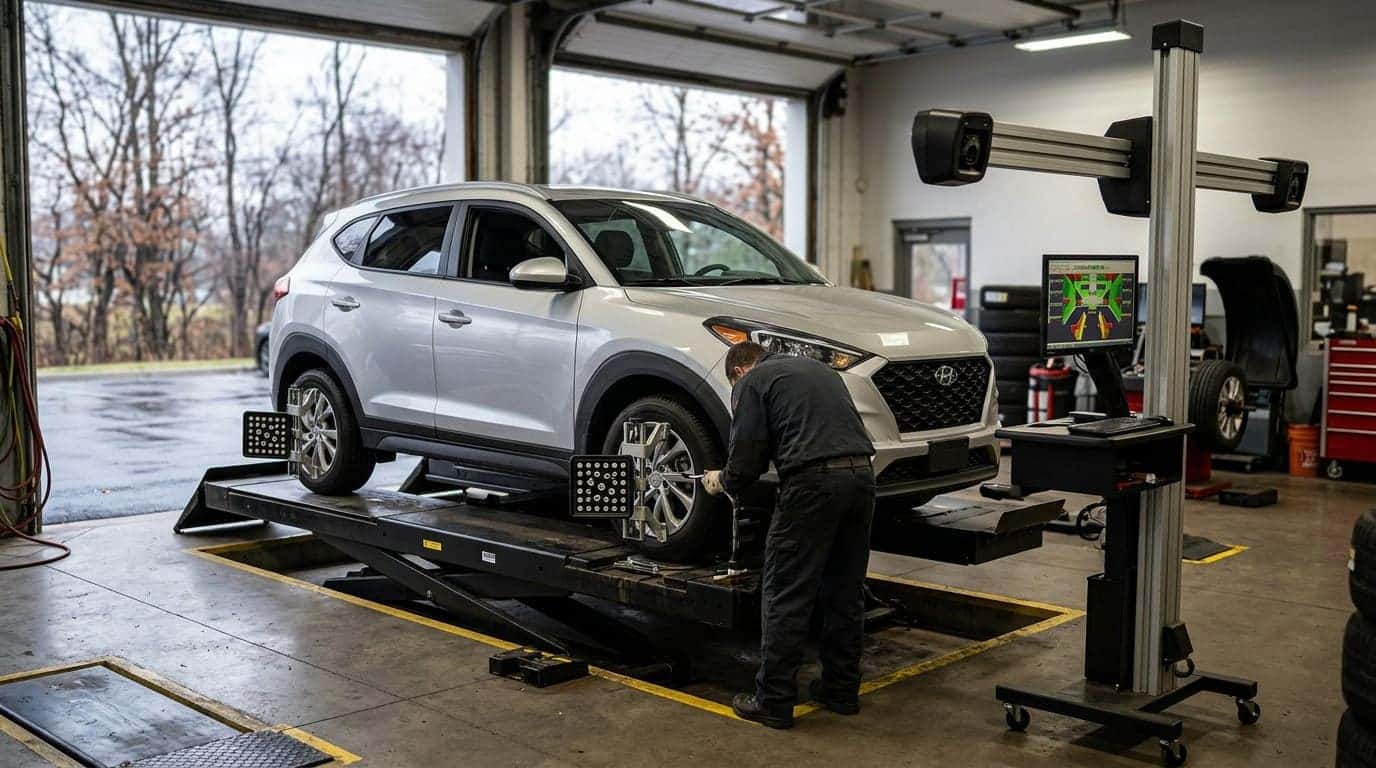
Wheel alignment adjusts the angles of your vehicle’s steering and suspension components so your tires travel straight and make proper contact with the road, whereas tire balancing corrects uneven weight distribution within the tire and wheel assembly. During winter driving, proper wheel alignment keeps your vehicle tracking straight on icy or slushy roads, while tire balancing eliminates high-speed wheel vibration and maintains steady, consistent tread traction.
Understanding how these two maintenance procedures differ is essential for navigating challenging cold-weather road conditions. Wheel alignment focuses entirely on angles—specifically camber, caster, and toe. When a vehicle is properly aligned, all four wheels point in the exact direction intended by the manufacturer. Misalignment causes tires to scrub sideways across the road surface. On slick winter pavement, even minor steering misalignment drastically reduces directional control and stability.
Tire balancing addresses weight distribution around the rotating wheel assembly. Even factory-new tires and wheels have slight variations in weight distribution. Technicians place precise counterweights on the wheel rim using high-speed dynamic balancing equipment. When an unbalanced tire spins at highway speeds, those tiny weight discrepancies cause the wheel to hop or wobble. This vibration creates micro fractions of air space between the tire tread and the road, compromising traction when you need it most.
“`
Wheel Alignment vs. Tire Balancing Summary
Service Primary Focus Key Adjustment Winter Benefit
Wheel Alignment Suspension Geometry Camber, Caster, Toe Straight tracking & full contact patch
Tire Balancing Weight Distribution Rim Counterweights Smooth rotation & vibration elimination
“`
Both services work together to protect your tires and preserve vehicle handling. An aligned vehicle with unbalanced tires will still experience steering wheel shimmy and uneven tread wear. Conversely, balanced tires mounted on a misaligned suspension will wear down rapidly on one edge while pulling toward the shoulder. For expert service on your vehicle’s tires, wheels, and steering systems, you can reach our team at (615) 442-3090 or visit our Gallatin service department to ensure your vehicle is ready for winter.
Table of Contents
- How do misaligned wheels and unbalanced tires compromise winter driving control?
- How often should you get a wheel alignment and tire balancing done?
- Why is four-wheel alignment critical for AWD vehicles in winter conditions?
- Are all-season tires sufficient for winter driving conditions in Middle Tennessee?
- What maintenance checks and winter inspection packages protect your vehicle?
- Common Questions About Winter Tire Maintenance and Alignment in Middle Tennessee
How do misaligned wheels and unbalanced tires compromise winter driving control?
Misaligned wheels cause a vehicle to pull to one side and scrub tire tread sideways across slippery roads, while unbalanced tires reduce firm contact with the pavement through high-speed vibration. On icy or wet winter surfaces, these dual mechanical defects drastically reduce steering responsiveness and extend emergency stopping distances.
When driving in freezing temperatures, tread contact area is the single most critical factor in maintaining control. The Tennessee Emergency Management Agency cautions drivers that black ice frequently forms on bridges and overpasses when temperatures hover near freezing. If your vehicle’s alignment is out of specification, the full width of the tire tread cannot sit flat against the pavement. Driving with reduced tread contact on black ice makes maintaining a straight line extraordinarily difficult, forcing constant counter-steering corrections.
Unbalanced tires create a distinct hazard on slushy or wet highways. As the Tennessee Department of Transportation dispatches equipment to treat interstates with liquid salt brine, winter roads are often covered in a mixture of brine, melted snow, and road grime. An unbalanced wheel assembly vibrates rapidly at cruising speeds, breaking the continuous grip between the rubber and the road. This micro bouncing effect allows slush to build up under the tire footprint, increasing the risk of hydroplaning and loss of control.
Our service advisors often see drivers come in noticing a slight steering wheel vibration after early winter temperature drops, assuming they need expensive brake work when the actual culprit is simply an unbalanced tire assembly compounded by summer pothole wear. Eliminating these mechanical vibrations restores precise steering feedback through the wheel. If you are considering upgrading your primary family vehicle before winter arrives, exploring our selection of pre-owned vehicles gives you access to late-model cars and crossovers equipped with modern safety features.
How often should you get a wheel alignment and tire balancing done?
Most passenger vehicles require a wheel alignment check at least once a year or every 12,000 miles, while tire balancing should be performed every 5,000 to 7,000 miles, typically alongside routine tire rotations. In Middle Tennessee, scheduling a combined alignment and balancing check every fall ensures your vehicle is prepared for seasonal temperature drops and winter road hazards.
While annual checks serve as a solid baseline, real-world driving conditions often dictate a more frequent schedule. Summer heat, rough road surfaces, and sudden temperature shifts alter tire pressures and stress suspension bushings. Striking a curb or hitting a severe road imperfection can instantly knock wheel angles out of alignment. Paying attention to warning signs helps prevent compounding damage to your tires and suspension.
- Steering wheel pull: The vehicle drifts or pulls to the left or right while traveling straight on a level highway.
- Off-center steering wheel: The steering wheel sits crooked or off-center while driving straight ahead.
- Uneven tread wear: The inner or outer edges of your tire tread wear down significantly faster than the center tread.
- Steering wheel vibration: A persistent shimmy or shaking sensation felt through the steering column or floorboard at speeds above 45 mph.
Local drivers navigating the rural agricultural routes around Cross Plains know that hidden potholes and rough road edges can alter wheel alignment long before an annual service interval comes due. Having suspension angles verified before severe weather arrives keeps tread wear even and extends overall tire life. If you are contemplating trading in your current vehicle for a model with updated driver-assist features and active safety technology, you can easily value your trade-in online to see how much equity you hold.
Why is four-wheel alignment critical for AWD vehicles in winter conditions?
Four-wheel alignment is critical for all-wheel-drive vehicles in winter because improper wheel angles create uneven tire wear and inconsistent rolling circumferences, putting excessive mechanical strain on the transfer case and center differential. Maintaining precise four-wheel alignment ensures that power distribution across all four wheels remains smooth and predictable on low-traction surfaces.
Modern all-wheel-drive systems monitor wheel speed sensors hundreds of times per second to detect slippage. Models like the 2026 Nissan Rogue feature an advanced powertrain with a 1.5L engine paired with an Xtronic transmission, delivering 201 hp and 225 lb-ft of torque through available intelligent all-wheel drive. If the rear wheels are misaligned relative to the front wheels, the tires drag and rotate at fractionally different speeds even while traveling straight. The vehicle’s computer may interpret this continuous speed differential as wheel slip, engaging the AWD system unnecessarily and causing mechanical binding.
“`
AWD Wheel Alignment Impact Overview
System Component Impact of Misalignment Winter Risk
Center Differential Thermal stress from speed delta Fluid breakdown & component drag
Transfer Case Continuous torque compensation Premature gear wear
Traction Control False wheel-slip detection Inconsistent engine power cuts
Tire Footprint Uneven contact across axles Predictability loss on ice
“`
For larger family vehicles like the 2026 Nissan Pathfinder—equipped with a 3.5L V6 engine, a 9-speed automatic transmission, available AWD, and up to 6,000 lbs of towing capacity—proper alignment across all four wheels is vital for maintaining straight-line stability when hauling cargo or trailers on slick roads. When all four wheels are properly aligned, power transfers seamlessly to the tires with the most grip. Drivers interested in upgrading to an AWD crossover can browse our new vehicle inventory, review why drivers choose Newton Nissan of Gallatin, or apply for financing online to secure competitive payment terms.
Engine & Performance
Powertrain specs by trim
| Feature | Dark Armor | Dark Armor AWD | Platinum AWD | Rock Creek AWD |
|---|---|---|---|---|
| Engine | 1.5L | 1.5L | 1.5L | 1.5L |
| Horsepower | 201 hp | 201 hp | 201 hp | 201 hp |
| Torque | 225 lb-ft | 225 lb-ft | 225 lb-ft | 225 lb-ft |
| Transmission | Xtronic | Xtronic | Xtronic | Xtronic |
| Drivetrain | Front-wheel drive | All-wheel drive | All-wheel drive | All-wheel drive |
Engine & Performance (continued)
| Feature | S AWD | S FWD | SL AWD | SL FWD |
|---|---|---|---|---|
| Engine | 1.5L | 1.5L | 1.5L | 1.5L |
| Horsepower | 201 hp | 201 hp | 201 hp | 201 hp |
| Torque | 225 lb-ft | 225 lb-ft | 225 lb-ft | 225 lb-ft |
| Transmission | Xtronic | Xtronic | Xtronic | Xtronic |
| Drivetrain | All-wheel drive | Front-wheel drive | All-wheel drive | Front-wheel drive |
Engine & Performance (continued)
| Feature | SV AWD | SV FWD |
|---|---|---|
| Engine | 1.5L | 1.5L |
| Horsepower | 201 hp | 201 hp |
| Torque | 225 lb-ft | 225 lb-ft |
| Transmission | Xtronic | Xtronic |
| Drivetrain | All-wheel drive | Front-wheel drive |
Are all-season tires sufficient for winter driving conditions in Middle Tennessee?
All-season tires are generally sufficient for typical Middle Tennessee winter weather—including light snow and freezing rain—provided they maintain adequate tread depth and correct inflation pressures. However, all-season rubber compounds begin to stiffen when ambient temperatures drop below 45 degrees Fahrenheit, making proper wheel alignment and tread health vital for cold-weather safety.
Tread depth plays a decisive role in how well an all-season tire handles winter wetness. While the legal minimum tread depth is 2/32-inch, tires worn to this limit cannot channel slush or water away from the contact patch effectively. Maintaining a minimum tread depth of 4/32-inch during winter months provides the necessary biting edges to grip wet or frosty pavement. Cold weather also reduces tire pressure by roughly 1 PSI for every 10-degree drop in outdoor temperature, making regular inflation checks essential.
Commuters traveling the state routes around Portland encounter sudden weather changes across rolling suburban terrain, where maintaining correct tire tread depth and alignment prevents traction loss during morning cold snaps. Proper tire care also maximizes the practical utility of versatile vehicles like the 2026 Nissan Rogue, which offers comfortable seating for 5 passengers and up to about 36.5 cu ft of cargo space behind the second row on SL and Platinum trims (about 32 cu ft on S and SV trims). If your vehicle requires fresh wiper blades, winter floor mats, or replacement tires, ordering factory-direct parts online ensures exact fitment and original equipment reliability.
Dimensions & Capacity
Capacity and dimensions by trim
| Feature | Dark Armor | Dark Armor AWD | Platinum AWD | Rock Creek AWD |
|---|---|---|---|---|
| Seating | 5 | 5 | 5 | 5 |
| Cargo | 31.6 cu ft | 31.6 cu ft | 36.5 cu ft | 31.6 cu ft |
| Curb weight | 3,530 lbs | 3,657 lbs | 3,737 lbs | 3,713 lbs |
| Payload | 1,111 lbs | 1,116 lbs | 996 lbs | 972 lbs |
Dimensions & Capacity (continued)
| Feature | S AWD | S FWD | SL AWD | SL FWD |
|---|---|---|---|---|
| Seating | 5 | 5 | 5 | 5 |
| Cargo | 31.6 cu ft | 31.6 cu ft | 36.5 cu ft | 36.5 cu ft |
| Curb weight | 3,607 lbs | 3,607 lbs | 3,694 lbs | 3,565 lbs |
| Payload | 1,166 lbs | 1,034 lbs | 1,039 lbs | 1,076 lbs |
Dimensions & Capacity (continued)
| Feature | SV AWD | SV FWD |
|---|---|---|
| Seating | 5 | 5 |
| Cargo | 31.6 cu ft | 31.6 cu ft |
| Curb weight | 3,657 lbs | 3,530 lbs |
| Payload | 1,116 lbs | 1,111 lbs |
What maintenance checks and winter inspection packages protect your vehicle?
Bundling wheel alignment, tire balancing, and a comprehensive multi-point inspection before winter arrives protects steering components, prevents premature tire failure, and reduces overall ownership costs. Preparing your vehicle before severe cold sets in ensures that minor mechanical wear is addressed before it causes secondary damage.
A thorough pre-winter inspection goes beyond tire tread to evaluate key chassis, suspension, and electrical systems:
- Suspension components: Inspection of tie rod ends, control arm bushings, ball joints, and shock absorbers to ensure steering linkages hold accurate alignment settings.
- Brake system health: Measurement of brake pad thickness, rotor surface condition, and brake fluid moisture levels to guarantee responsive stopping power on icy roads.
- Battery and charging performance: Testing cold cranking amps and terminal connections, as cold temperatures significantly reduce battery output.
- Undercarriage protection: Checking protective rubber boots and seals that shield vital steering components from liquid road salt and de-icing chemicals.
Combining these checks into a single seasonal service appointment ensures your vehicle operates efficiently and reliably through unpredictable winter weather.
Common Questions About Winter Tire Maintenance and Alignment in Middle Tennessee
Q: How do I know if my steering pull is caused by bad alignment or uneven tire pressure?
Check your tire inflation pressure when the tires are cold, inflating them to the recommended PSI listed on your driver-side door placard. If the vehicle continues to pull to one side on a flat, straight road after tire pressures are equalized, the cause is almost certainly improper wheel alignment or uneven tire tread wear patterns.
Q: Can I perform a DIY wheel alignment or tire balancing at home before winter?
Precise wheel alignment requires specialized digital laser alignment machines to adjust angles down to hundredths of a degree, while tire balancing requires high-speed dynamic balancing equipment to locate minor weight variances. Professional service ensures exact calibration according to factory specifications, which cannot be accurately replicated using manual tools in a home garage.
Q: What is the minimum tread depth required for safe driving on slippery roads?
While the absolute legal minimum threshold is 2/32-inch, winter driving safety guidelines from the Tennessee Emergency Management Agency recommend maintaining at least 4/32-inch of tread depth for driving on wet, slushy, or snow-covered roads. Tires worn down to 2/32-inch lose their ability to channel water away from the contact patch, dramatically increasing stopping distances.
Q: Will driving with misaligned wheels damage my all-wheel-drive system?
Yes, misaligned wheels cause uneven tread wear across different tires, creating variations in overall rolling circumferences. On all-wheel-drive systems, differences in tire rotational speeds trick differentials and transfer cases into slipping continuously, leading to excessive heat, premature fluid breakdown, and potential mechanical wear during winter driving.
Q: Why does tire pressure drop rapidly during early winter cold snaps?
Tire pressure decreases naturally by approximately 1 PSI for every 10-degree drop in outdoor temperature because air molecules contract in cold conditions. When autumn transitions to winter in Middle Tennessee, sudden ambient temperature drops can cause tire pressures to fall 3 to 5 PSI below recommended settings, impairing traction and accelerating shoulder wear.
Preparing Your Vehicle for Winter Driving Safety
Taking proactive steps before cold weather arrives keeps your family safe and ensures predictable handling across all road conditions. Proper wheel alignment, dynamic tire balancing, and regular inflation checks prevent premature wear while maximizing traction on wet, icy pavement. Our factory-trained service team is ready to inspect your steering and suspension systems using advanced diagnostic equipment. You can reach us directly at (615) 442-3090, stop by our Gallatin service center address, or discover more about our community involvement initiatives to see how we support local drivers year-round.
0 comment(s) so far on What is the difference between wheel alignment and tire balancing for winter driving?