


Where Will You Feel Vibration If Front Tires Are Unbalanced?
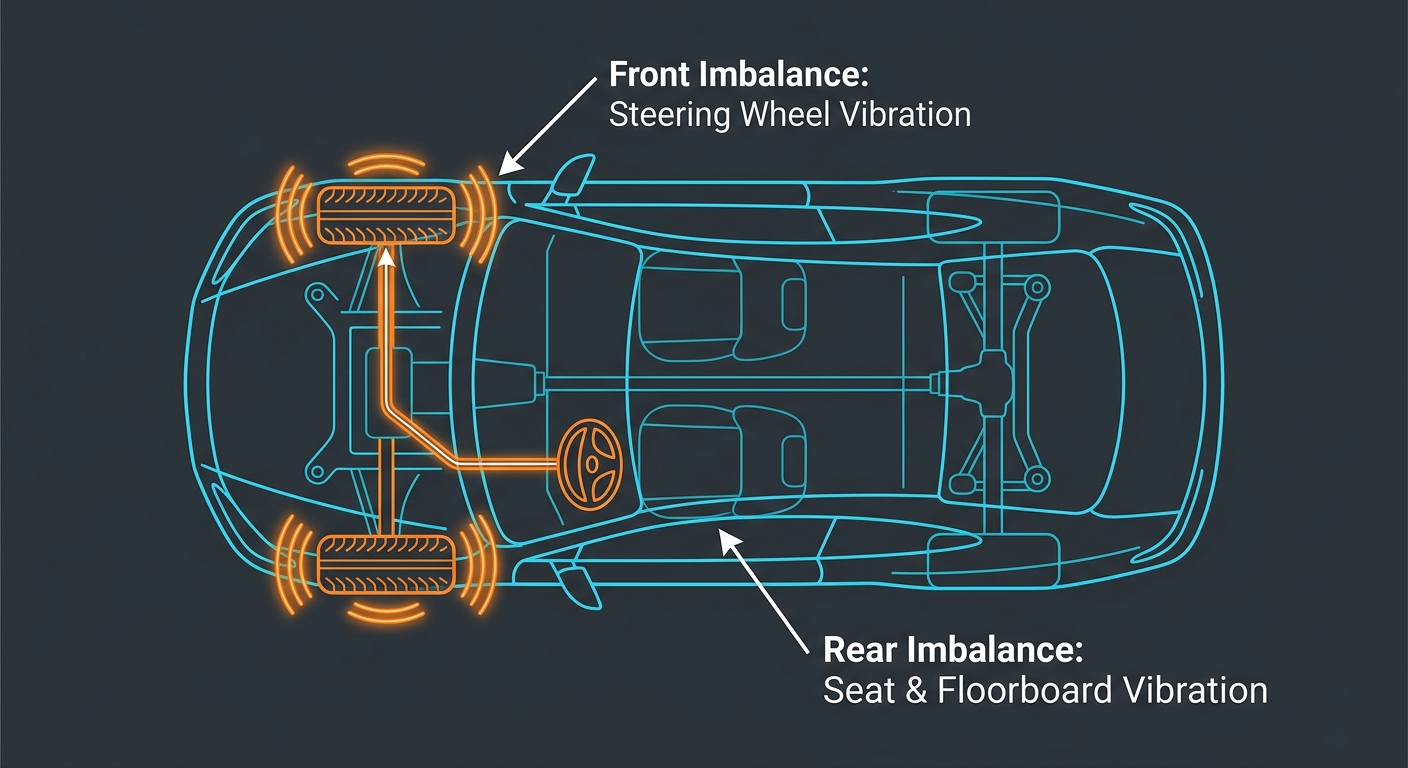
When front tires are unbalanced, you will feel the resulting vibration directly through the steering wheel. This shaking typically becomes noticeable at highway speeds between 50 and 60 mph, creating a rhythmic wobble in your hands that often worsens as vehicle speed increases. If the vibration is felt instead through your seat or vehicle floorboard, the imbalance is usually located in the rear tires rather than the front.
A weight variance as small as half an ounce across a tire assembly can create noticeable mechanical chatter once the tire rotates hundreds of times per minute. Front wheels directly connect to your vehicle’s steering rack and column. Because there is minimal mechanical damping between the front wheel hub and the steering wheel, even tiny weight inconsistencies send vibrations straight up through the steering shaft into the driver’s hands.
Daily commuters driving from Portland toward Nashville on Highway 31W often spot these front-end imbalances when accelerating up to cruising speed, as the vibration becomes noticeable and affects steering control. The vibration tends to peak around 55 mph and may smooth out slightly at higher speeds, though the ongoing weight imbalance continues to stress your steering linkage, wheel bearings, and tie rod ends. Ignoring front-end vibration leads to cupped or uneven tread wear, which shortens tire lifespan and compromises wet-weather traction.
When drivers bring their vehicles to our service center in Gallatin for vibration diagnostics, our technicians mount each wheel on a dynamic computer balancer. This machine spins the assembly to pinpoint minute heavy spots and indicates precisely where counterweights belong along the wheel rim. If your steering wheel has started shaking during highway drives, give our service team a quick call to schedule a balance check before uneven wear develops.
Table of Contents
- What Is the Difference Between Wheel Alignment and Tire Balancing?
- Can You Have Tire Balancing Performed Without a Wheel Alignment?
- Why Is Your Vehicle Pulling to One Side Versus Shaking the Steering Wheel?
- Do You Need an Alignment Every Time You Rotate Your Tires?
- What Are Camber, Toe, and Caster Alignment Angles and How Do They Impact Driving?
- How Proper Tire Care Extends Vehicle Lifespan and Saves Fuel
- Common Questions About Tire Alignment and Balancing
- Schedule Trusted Nissan Tire Service in Gallatin
What Is the Difference Between Wheel Alignment and Tire Balancing?
Wheel alignment adjusts suspension angles so your tires contact the road at the correct orientation, while tire balancing equalizes weight distribution around the entire wheel and tire assembly. Alignment fine-tunes components like control arms and tie rods, whereas balancing attaches precise weights to the wheel rim to achieve smooth rotation.
Understanding how these two maintenance tasks differ helps you address specific driving symptoms before they cause lasting vehicle wear:
- Wheel Alignment: Focuses on steering and suspension geometry. Technicians adjust camber, toe, and caster angles so the vehicle tracks straight without pulling. Proper alignment prevents severe edge wear along the inner or outer shoulders of the tread.
- Tire Balancing: Focuses on mass distribution. Technicians compensate for natural manufacturing variances and heavy spots in the tire rubber or wheel casting. Proper balancing eliminates speed-dependent vibrations felt in the cabin or steering wheel.
A vehicle can have perfectly balanced wheels while suffering from severely misaligned suspension, just as a perfectly aligned suspension can still experience high-speed shaking if a wheel balance weight falls off. Heavier family vehicles like the Nissan Pathfinder benefit from regular evaluation of both systems to preserve cabin quietness and tire longevity. If you are exploring our pre-owned Nissan inventory, rest assured that pre-delivery mechanical inspections evaluate both alignment and balance so your vehicle drives smoothly from day one.
Can You Have Tire Balancing Performed Without a Wheel Alignment?
Tire balancing and wheel alignment are independent maintenance services, so you can balance your tires without aligning the suspension. Balancing deals strictly with rotational mass on the wheel hub, while alignment adjusts the mechanical angles of your steering linkages and suspension control arms.
There are several standard vehicle care scenarios where performing tire balancing alone is appropriate:
- Mounting a new set of tires onto your existing wheels
- Rebalancing a wheel after a puncture repair or valve stem replacement
- Rebalancing front wheels after losing a clip-on rim weight on rough road surfaces
- Addressing speed-dependent steering wheel shake when your vehicle still tracks straight
Conversely, if your vehicle pulls hard to one side on flat roads or shows diagonal wear across the tread blocks, balancing alone will not resolve the issue. In those situations, a complete alignment check is required. Maintaining proper wheel service history preserves your vehicle’s overall resale appeal when you decide to value your trade-in online for a newer vehicle.
Why Is Your Vehicle Pulling to One Side Versus Shaking the Steering Wheel?
A vehicle pulling or drifting to one side indicates misaligned wheel suspension angles, whereas steering wheel shaking signifies a weight imbalance in the front tires. Pulling forces you to apply constant counter-steering pressure to keep the vehicle straight, while balancing issues create a cyclic shaking motion that changes frequency with road speed.
Suspension misalignment actively pushes your tires out of alignment relative to the vehicle’s centerline. When toe or camber settings drift out of specification, one tire drags slightly sideways across the asphalt, pulling the vehicle toward the shoulder or median. Navigating the uneven gravel back roads and rural routes around Cross Plains puts continuous stress on suspension bushings and ball joints, making alignment drift more common over time.
By contrast, wheel vibration is dynamic and rotation-based. An unbalanced tire hops or wobbles on its spindle every time the heavy spot reaches the top of its rotation. Truck owners driving the Nissan Frontier with its 3.8L V6 engine and 6,680 lbs towing capacity rely on precise steering alignment and balanced wheels to maintain trailer stability and highway confidence under load.
If your vehicle exhibits either symptom, our factory-trained service team can quickly isolate the root cause. You can browse our new Nissan inventory to discover vehicles equipped with advanced driver-assist features that function best when suspension alignment is within factory specs. Learn more about why local drivers choose Newton Nissan of Gallatin for dependable service, or apply for financing online when preparing for your next purchase.
Do You Need an Alignment Every Time You Rotate Your Tires?
An alignment is not required every time you rotate your tires, but having technicians inspect tread depth patterns during routine rotations helps identify alignment issues early. Tire rotations simply swap wheel positions to promote even tread wear across all four tires.
Tires should typically be rotated and balanced every 5,000 to 7,500 miles, which conveniently aligns with routine oil change intervals. Wheel alignment, however, is generally recommended every 12,000 to 15,000 miles or whenever you experience direct steering feedback issues, such as tracking drift or uneven shoulder wear.
Combining tire rotations with routine alignment checks prevents localized tread damage from spreading across all four wheel positions. If a misaligned front wheel causes inner-edge wear, rotating that tire to the rear without correcting the suspension angle simply exposes a fresh tire to the same damaging alignment angle. When you need replacement components, tire pressure sensors, or maintenance items, you can conveniently order genuine Nissan parts online directly from our dealership.
What Are Camber, Toe, and Caster Alignment Angles and How Do They Impact Driving?
Wheel alignment relies on three primary geometric settings: camber, toe, and caster. Each angle governs a specific aspect of tire contact, directional stability, and steering responsiveness.
Alignment Angle Quick Reference:
| • Camber | Inward (-) or outward (+) tilt from vertical -> Controls shoulder wear & cornering grip |
| • Toe | Points inward (toe-in) or outward (toe-out) -> Controls straight tracking & scrub wear |
| • Caster | Pivot angle tilt forward (-) or backward (+) -> Controls straight stability & steering return |
Understanding Camber Angle
Camber describes the inward or outward tilt of the tire relative to a vertical line viewed from the front of the vehicle:
- Negative Camber: The top of the tire tilts inward toward the engine bay. A small amount improves cornering grip, but excessive negative camber wears out the inner tread edge.
- Positive Camber: The top of the tire tilts outward away from the body. Excessive positive camber concentrates load on the outer shoulder of the tire.
Most modern road alignment specifications target a neutral camber range near 0°, typically between -0.5° and +0.5°.
Understanding Toe Angle
Toe represents the direction tires point relative to the vehicle’s centerline when viewed from directly above:
- Toe-In: The front edges of the tires point slightly toward each other. A small amount of toe-in (around 0° to 0.20° total) promotes stable, straight-line highway tracking.
- Toe-Out: The front edges of the tires point away from each other. Toe-out causes rapid rubber scrubbing across the tread blocks and induces twitchy steering response.
Incorrect toe is the single leading cause of premature tire tread wear.
Understanding Caster Angle
Caster measures the forward or backward tilt of the steering pivot axis when viewed from the side of the vehicle:
- Positive Caster: The pivot axis tilts backward toward the driver (around 3° to 4.5° positive on most passenger vehicles). This angle generates self-centering force that helps the steering wheel return to center automatically after a turn.
- Negative Caster: The pivot axis tilts forward, which creates light steering feel but severely degrades straight-line directional stability.
While caster rarely causes direct tire tread wear, correct setting is essential for relaxed highway cruising and steering control.
How Proper Tire Care Extends Vehicle Lifespan and Saves Fuel
Maintaining correct tire balance and alignment minimizes rolling resistance, allowing your engine or electric drive system to push the vehicle forward with minimal energy loss. When tires are misaligned or out of balance, they drag slightly across the pavement, consuming extra fuel and increasing overall ownership costs.
Proper tire maintenance protects critical undercarriage components in several measurable ways:
- Reduces Drivetrain Friction: Correctly aligned wheels eliminate unnecessary scrub drag, contributing directly to real-world fuel savings on daily commutes.
- Extends Suspension Life: Eliminating high-speed wheel bounce reduces cyclic impact loads on strut dampeners, ball joints, control arm bushings, and wheel bearings.
- Prevents Tread Feathering: Even weight distribution keeps tread blocks laying flat against the asphalt, preventing feathering, cupping, and premature tire replacement.
- Optimizes Safety Tech: Driver-assist technology, lane-keeping systems, and automated braking rely on accurate wheel tracking and steering angle sensor calibration.
Investing in regular tire rotations, balance checks, and alignment verification ensures your vehicle remains reliable, safe, and economical over every mile.
Common Questions About Tire Alignment and Balancing
Q: How long does a tire balancing and alignment service take at the dealership?
A standard tire balancing service takes approximately 30 to 45 minutes, while a comprehensive four-wheel alignment typically requires about an hour. During a multi-point inspection, our technicians also evaluate related undercarriage health, including suspension links and brake components. If your visit includes baseline checks, you can also explore our battery service options to keep your vehicle starting reliably.
Q: Will unbalanced tires damage my vehicle’s suspension over time?
Yes, driving continuously on unbalanced tires damages steering and suspension components. The violent dynamic shaking generated by an unbalanced wheel creates continuous impact stress on wheel bearings, shock absorbers, tie rod ends, and rubber suspension bushings. Over thousands of miles, this vibration accelerates wear on expensive undercarriage assemblies and leads to premature part failure.
Q: Can hitting a pothole knock out my wheel alignment instantly?
Hitting a deep pothole, striking a curb hard, or driving over debris at speed can instantly knock your suspension out of alignment. The impact force can slightly bend a tie rod, shift a control arm, or alter strut mounting points. If your steering wheel sits crooked or your vehicle pulls immediately after an impact, bring it in for an alignment check right away.
Q: How do I know if a vibration is from an unbalanced tire or a bent wheel?
Tire imbalance causes speed-dependent vibration that typically appears around 50 to 60 mph. A bent wheel rim often causes physical vibration or wobble across a broader speed range, including slow speeds, and may be accompanied by persistent tire pressure loss. Our technicians use computerized wheel balancing equipment to measure wheel runout and distinguish between tire mass weight variance and structural rim damage.
Q: Do modern driver-assist systems require realignment after an alignment procedure?
Yes, modern vehicles equipped with lane-departure warnings, automatic emergency braking, and adaptive cruise control rely on precise steering angle sensor calibration. When technicians adjust mechanical alignment angles, they also calibrate the steering angle sensor so driver-assist electronics accurately read vehicle trajectory and keep you safe on the road.
Schedule Trusted Nissan Tire Service in Gallatin
Maintaining properly aligned and balanced tires is essential for smooth handling, fuel efficiency, and tire longevity. Whether you noticed a slight steering wheel shake during your morning commute or simply want to stay on top of scheduled maintenance, our factory-trained service team is ready to help. Visit us at 1461 Nashville Pike, Gallatin, TN 37066 or give our service department a call at (615) 442-3090 to schedule your tire alignment and balancing appointment today.
0 comment(s) so far on Where Will You Feel Vibration If Front Tires Are Unbalanced?