

Why Is My Steering Wheel Crooked When I’m Going Straight?
Why Is My Steering Wheel Crooked When I’m Going Straight?
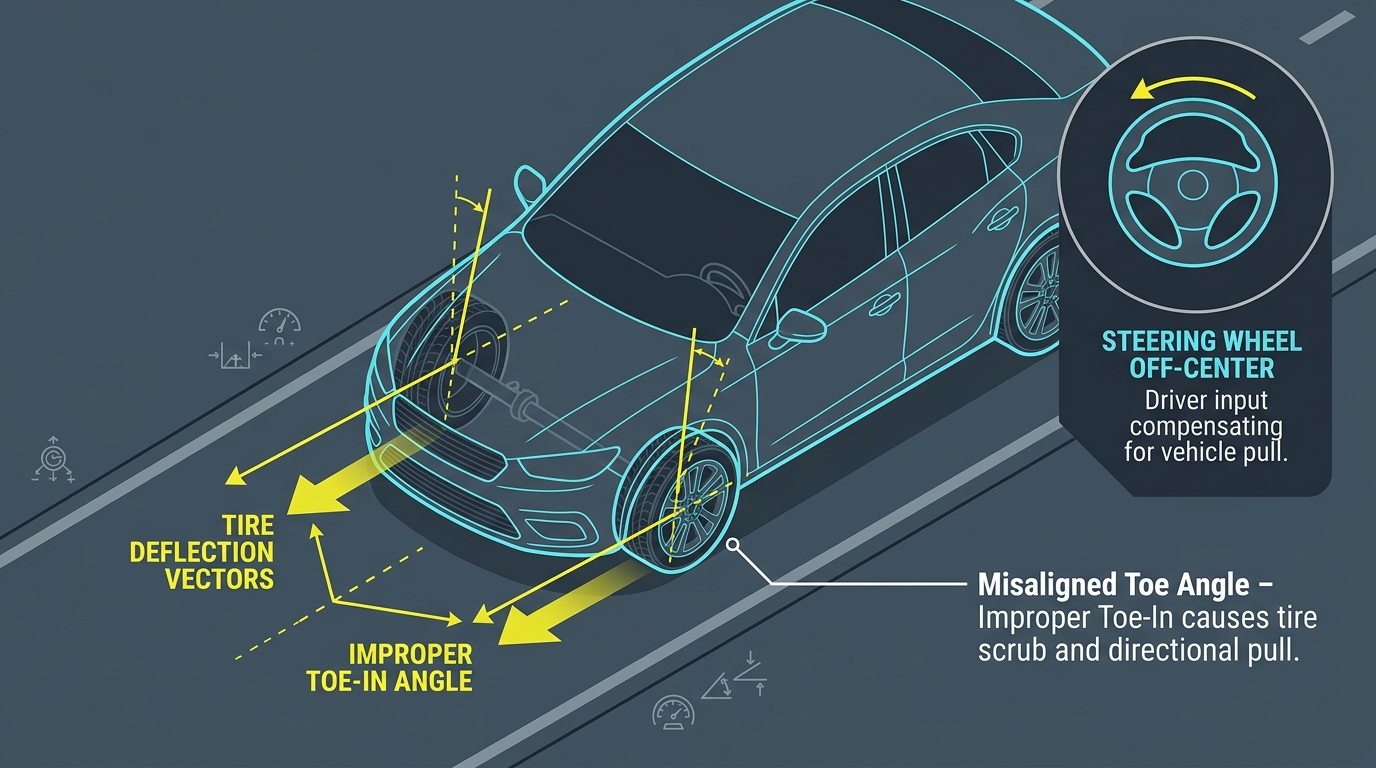
A crooked steering wheel while driving straight is primarily caused by improper suspension alignment, specifically an offset toe angle or altered thrust angle. When front wheels point slightly inward or outward relative to the vehicle’s centerline—often after hitting a severe pothole, curbing a tire, or experiencing suspension component wear—the steering gear must be turned off-center to keep the vehicle traveling straight down the road.
Steering angle discrepancies usually trace back to small shifts in steering linkages or tie rod positions. When you hit a road hazard, the impact transfers directly through the wheel hub into the steering rack. Even a minor bend in a tie rod forces your vehicle to drift off track unless you turn the steering wheel slightly to compensate. Over time, driving with an unaligned steering wheel causes rapid, uneven tire wear along the inner or outer tread shoulders.
Modern vehicles rely on exact steering position inputs to operate advanced safety systems properly. When the steering wheel remains angled while driving straight, the vehicle’s steering angle sensor reports a continuous turn to internal control modules. This mismatch can trigger false interventions or warning lights from driver-assist technologies like Nissan Safety Shield 360.
Drivers navigating the rural farm routes around Cross Plains often encounter unexpected bumps or uneven pavement that can knock alignment out of specification. If you notice your steering wheel sitting crooked on a flat, straight road, bring your vehicle to our Gallatin service location for a quick digital suspension check. You can also give our team a quick call to speak with a technician or learn more about why drivers choose our dealership for precise suspension maintenance.
Table of Contents
- What Is the Difference Between Wheel Alignment and Tire Balancing?
- Can You Perform a Tire Alignment or Balancing Service Separately?
- Diagnosing Pulling Steering Versus Highway Steering Wheel Vibration
- Do You Need a Wheel Alignment During a Standard Tire Rotation?
- What Are Camber, Toe, and Caster Angles and How Do They Cause Tire Wear?
- How Misaligned Angles Impact Driving Safety and Maintenance Costs
- Common Questions About Steering Alignment and Tire Balancing
- Schedule Professional Tire Maintenance at Newton Nissan of Gallatin
What Is the Difference Between Wheel Alignment and Tire Balancing?
Wheel alignment adjusts the suspension components that position your tires relative to the road and vehicle centerline, while tire balancing equalizes weight distribution around the wheel and tire assembly. Alignment prevents steering pull and directional drift, whereas balancing eliminates high-speed vibrations and uneven tread cupping.
Understanding these two services helps drivers address specific steering symptoms accurately:
- Wheel Alignment: Focuses on physical suspension angles known as camber, toe, and caster. Technicians use laser-guided equipment to adjust tie rods, control arms, and strut mounts so all four tires remain parallel to each other and perpendicular to the road surface.
- Tire Balancing: Addresses weight heavy spots within the rubber tread or alloy wheel. Technicians place the wheel assembly onto a dynamic spinning balancer, locate tiny weight imbalances down to fractions of an ounce, and attach small counterweights along the inner or outer rim flange.
| Maintenance Service | Primary Component Adjusted | Main Symptom Corrected | Typical Service Frequency |
|---|---|---|---|
| Wheel Alignment | Suspension linkages & steering geometry | Vehicle pulling left/right, crooked wheel | Once per year or after hard impacts |
| Tire Balancing | Wheel rim & tire weight distribution | Steering wheel vibration at highway speed | Every 5,000 to 6,000 miles |
Maintaining proper alignment and balance ensures your tires ride smooth and wear evenly. If you are considering upgrading your daily ride, feel free to explore our selection of new Nissan models equipped with comfortable suspension systems and advanced safety tech.
Can You Perform a Tire Alignment or Balancing Service Separately?
Yes, wheel alignment and wheel balancing are independent mechanical procedures that can be performed separately based on your vehicle’s specific symptoms. A car suffering from steering pull requires an alignment, whereas a vehicle experiencing highway chassis vibration requires tire balancing.
While both services target tire longevity and vehicle handling, they utilize completely different diagnostic tools and service bays. Balancing requires dismounting the wheel from the vehicle hub and mounting it to a dynamic spin balancer. An alignment keeps wheels installed on the vehicle while electronic sensors measure the geometric alignment of your front and rear axles.
Performing one service without the other is completely appropriate when symptoms clearly point to a single cause. For instance, if you get a flat tire patched and feel a slight vibration afterward, a simple wheel balance solves the issue. However, combining both services during major service milestones maximizes tire lifespan and maintains optimal fuel savings.
If you are currently cross-shopping pre-owned cars, inspecting tire condition gives key insights into past owner care. Check out our high-quality pre-owned vehicle inventory to see models that have passed thorough multi-point safety inspections.
Diagnosing Pulling Steering Versus Highway Steering Wheel Vibration
A vehicle pulling to one side indicates an alignment discrepancy or uneven tire pressure, while steering wheel vibration at highway speeds points to an unbalanced front wheel assembly. Dissecting these distinct symptoms allows technicians to apply the precise corrective service without unnecessary labor.
Distinguishing steering drift from high-speed vibration boils down to how the vehicle behaves under steady momentum:
- Directional Pull: If you briefly loosen your grip on the steering wheel on a level highway, a misaligned vehicle continuously strays left or right. This force remains present at low speeds, high speeds, and during mild acceleration.
- Highway Vibration: An unbalanced wheel creates an annoying shimmy through the steering wheel column or floorboard, typically appearing between 55 mph and 70 mph. The vibration grows stronger as speed increases and diminishes when slowing down.
Commuters traveling daily along state routes out of Portland frequently notice highway vibration around 60 mph, which signals front-wheel weight distribution errors rather than suspension misalignment. During routine service visits, owners often ask whether a shaking steering wheel indicates damaged tires or simply a balance correction. In most cases, a precision dynamic wheel balance restores smooth highway handling.
If you plan to refresh your household vehicle setup, you can value your trade-in online in just a few clicks to see what your current ride is worth.
Do You Need a Wheel Alignment During a Standard Tire Rotation?
A wheel alignment is not mandatory during a standard tire rotation, but having your alignment checked during rotation helps catch subtle suspension shifts before they ruin new tread. Routine tire rotations swap wheel positions to promote equal tread wear across all four positions.
Tire rotations move front tires—which bear engine weight and steering friction—to the rear axle, while moving rear tires forward. This process equalizes rubber wear across all four tires. An alignment, by contrast, mechanically adjusts tie rod threads and eccentric bolts to alter how the tires meet the highway.
Checking alignment during rotation interval service provides several distinct benefits:
- Early Problem Detection: Spotting uneven inner shoulder wear while tires are off the vehicle allows technicians to correct alignment before visible tread damage ruins tire life.
- Extended Tread Life: Combining rotation with accurate alignment geometry maximizes overall mileage warranty coverage.
- Improved Driving Safety: Ensures proper tire contact patch grip during wet weather braking and emergency lane shifts.
Keeping up with scheduled tire upkeep protects your auto investment. If you are preparing for your next vehicle purchase, you can get pre-approved for financing online to review competitive payment structures that fit your family budget.
What Are Camber, Toe, and Caster Angles and How Do They Cause Tire Wear?
The three main alignment settings— camber, toe, and caster—dictate how tires contact the road, absorb impacts, and wear over time. Incorrect toe causes rapid scrubbing across the tread, improper camber wears down inner or outer edges, and misaligned caster compromises straight-line tracking.
Understanding how these angles function clarifies why precise alignment adjustments are essential:
- Toe Alignment: Refers to whether the front edges of your tires point inward toward each other (toe-in) or outward away from each other (toe-out) when viewed from directly above. Misaligned toe forces rubber to drag sideways down the highway, causing sharp feathering edges along the tread blocks.
- Camber Angle: Measures the inward or outward vertical tilt of the tire when viewed from the front bumper. Negative camber tilts the top of the tire toward the engine, grinding down the inner shoulder. Positive camber tilts the tire outward, wearing down the outer tread wall.
- Caster Angle: Describes the forward or backward slope of the steering pivot axis when viewed from the side profile. Positive caster angles improve high-speed directional stability and help the steering wheel self-center after completing a turn.
| Alignment Angle | Viewpoint | What It Describes | Common Positions |
|---|---|---|---|
| Camber | Front view | The inward or outward vertical tilt of the wheel. | Negative camber / Positive camber |
| Toe | Top view | The direction the front edges of the tires point relative to each other. | Toe-in / Toe-out |
| Caster | Side view | The forward or backward slope of the steering pivot axis. | Negative caster / Positive caster |
When suspension parts like ball joints or tie rods wear down, these precise alignment angles shift out of factory tolerance. When you need replacement suspension components or tire hardware, you can order genuine Nissan parts online directly from our service center.
How Misaligned Angles Impact Driving Safety and Maintenance Costs
Ignoring misaligned steering angles accelerates tire wear, reduces emergency braking efficiency, and lowers overall fuel economy by increasing rolling resistance. Over time, driving with skewed suspension geometry puts unnecessary strain on steering linkages, ball joints, and wheel bearings.
When your tires do not roll completely parallel, your engine consumes extra energy pushing rubber through sideways resistance. This extra friction generates high internal tire heat, increasing the probability of highway blowouts. Misaligned tires also reduce water evacuation channels during heavy storms, increasing hydroplaning risks on wet highways.
Correcting alignment discrepancies early prevents expensive cascade repairs. Replacing a set of prematurely worn tires costs significantly more than routine suspension alignment checks. Proper alignment preserves overall suspension longevity, keeps steering response crisp, and delivers optimum miles per gallon.
Common Questions About Steering Alignment and Tire Balancing
Q: How long does a standard alignment and balancing service take?
A standard four-wheel alignment and high-speed tire balancing service typically takes between 45 and 60 minutes when performed by certified technicians. If your vehicle features advanced driver-assist systems like Nissan Safety Shield 360, recalibrating the front radar or lane-departure camera sensors during the alignment process may add an additional 30 minutes to ensure full system accuracy.
Q: Will driving with a crooked steering wheel damage my suspension?
Driving with an off-center steering wheel will not immediately destroy suspension hardware, but it accelerates uneven tire tread wear and places constant stress on tie rod ends and control arm bushings. Operating a vehicle with misaligned suspension geometry forces tires to drag sideways, generating high heat and reducing overall tread life by thousands of miles.
Q: Can a pothole impact ruin both alignment and wheel balance at once?
Hitting a severe pothole or sharp curb can easily knock your suspension out of alignment while simultaneously knocking wheel weights off the rim or bending the wheel structure. The sudden force alters tie rod positions and creates an instant weight imbalance, causing both steering drift and high-speed vibration.
Q: How often should alignment and balancing be inspected?
Tire balancing is recommended every 5,000 to 6,000 miles during routine tire rotations, while suspension alignment should be checked at least once a year. However, you should schedule an immediate inspection whenever you hit road debris, notice premature tire wear, or experience steering pull.
Q: Why does my car pull right even after a four-wheel alignment?
If your car pulls right after a precision alignment, the issue is often road crown—the slope built into highways for rain drainage—or radial tire pull caused by uneven internal tire wear. Technicians can perform a tire cross-rotation to determine whether the drift stems from the tires themselves or residual suspension tolerance differences.
To learn more about our team and how we serve local drivers, explore our community support initiatives or read about the Newton Certified Pre-Owned program benefits.
Schedule Professional Tire Maintenance at Newton Nissan of Gallatin
Addressing steering drift, crooked wheels, and tire vibrations promptly restores handling precision, maximizes fuel economy, and protects your tire investment. Our factory-trained service technicians utilize advanced laser alignment racks and dynamic computerized balancers tailored to exact manufacturer specifications.
If your vehicle pulls to one side or has a crooked steering wheel, do not delay routine tire upkeep. You can visit our Gallatin service center today for complete tire care or call our service department directly at (615) 442-3090 to reserve your next service appointment.
© 2026 Newton Nissan of Gallatin. All rights reserved.
0 comment(s) so far on Why Is My Steering Wheel Crooked When I’m Going Straight?